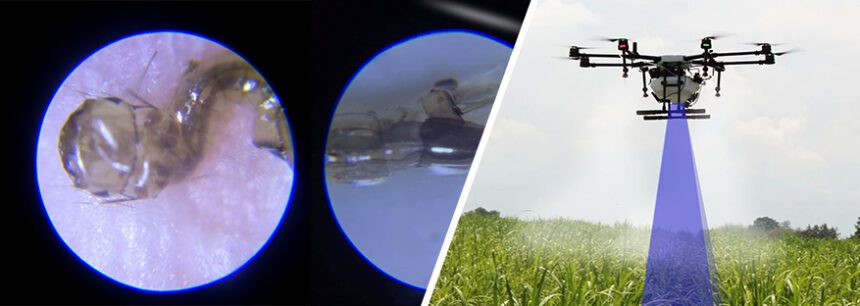
To combat the spread of malaria in developing regions such as sub-Saharan Africa,
Sriram Chellappan, a USF professor of computer science and engineering, played an
important part in developing drone mapping technology to locate habitats of malaria
spreading mosquitoes.
Earlier this year, USF College of Public Health research assistant professor Ben Jacobs
initiated a project to tackle malaria by encouraging local inhabitants in Uganda to
seek and destroy breeding habitats, before the larvae become adults. To make this
project a success, Chellappan’s expertise in AI and drones played an integral part.
“The malaria mortality rate in sub-Saharan Africa is upwards of 500,000 each year
with most of them being children,” Chellappan said. “Many more get infected and survive,
but impacts are severely debilitating. The idea we came up with was to find a way
to integrate drone technologies with artificial intelligence – mainly computer vision
– to enable real-time detection of habitats where Anopheles mosquitoes are likely
to lay eggs. This is because Anopheles mosquitoes alone spread malaria, and they are
endemic in sub-Saharan Africa and in many other countries as well.”
Chellappan and his student assistant, Mona Minakshi, developed a technique to automatically
detect sources of Anopheline breeding habitats from drone videos taken in sub-Saharan
Africa. Their technique, based on state-of-the-art convolutional neural networks,
not only detects where habitats are found in the videos but also localizes those habitats
via bounding boxes in the frames. In addition, they also process the videos to extract
GPS locations of habitats. All of this information is fed back in real-time to local
public health officials, so that local citizens can be mobilized to destroy these
habitats immediately.
“First, we received a number of training images from Uganda, wherein we were notified
exactly where the signatures of Anopheline breeding habitats within those images are,”
Chellappan said. “With these images, we built an AI algorithm that automatically detects
the signatures of breeding habitats and separates them from the background. Once we
receive videos from the field, we splice them into frames, and our algorithm then
processes each frame one by one to detect if any learnt signatures are present, and
if so, localizes them within the frame. These frames and the corresponding GPS locations
are sent back in real-time to public health officials in Uganda, and they immediately
mobilize personnel to destroy those habitats. We were notified that our algorithm
was highly accurate, and in fact many Anopheline breeding habitats were indeed eliminated,
hence contributing to controlling malaria.”
Results of this study will be published in an upcoming issue in The Journal of Public
Health and Epidemiology.
An instance of a predicted anopheles larval habitat created by the AI algorithm.
“I came to USF with a passion to do impactful research, and this project enabled me
to do just that – Research on AI for health in underserved communities,” Minakshi
said. “I vividly recall late night sessions where our team had to wait for drone videos
from Uganda. Upon receipt, we were excited to execute our AI algorithms to detect
potential Anopheline habitats.”
Manatee County was eager to discover a more cost-effective solution to their flood
water mosquito problem and decided that Jacobs’ drone mapping project was an ideal
solution. During a field test in Manatee County, Jacobs and his assistants successfully
verified that each habitat identified by the computer algorithms did in fact have
mosquito larvae.
“It was very satisfying to learn that our algorithm was successful at pinpointing
mosquito breeding grounds in Florida as well,” Chellappan said. “Also, we received
a new National Science Foundation award for our work on mosquito surveillance. This
new award further validates the importance of surveillance and control of mosquito-borne
diseases as perceived by NSF.”
The next step of this project is to add an insecticide delivery system to the drone
itself.
“Insecticides are commonly sprayed by helicopters and other vehicles unnecessarily
blanketing large areas,” he said. “This can cause issues with pollution and other
problems. With the use of our algorithm, the drone will detect and then target a breeding
ground, and a controlled amount of insecticide will be sprayed directly from the drone.
This will reduce the potential for rain runoff and wind drifting in high altitudes.”
Jacobs and Chellappan planned to test insecticide delivery in Manatee County, but
these plans were delayed by the COVID-19 outbreak.
“We’re all looking forward to seeing automatic habitat detection and insecticide delivery
via drones become a reality,” Chellappan said.