By using this site, you agree to the Privacy Policy and Terms of Use.
Accept
Sky Witness NewsSky Witness News
  • Home
  • Europe
    EuropeShow More
    Sky Witness News - Photo unavailableSky Witness News - Photo unavailable
    EU Drone Projects: The Art of Doing a Lot, Yet Producing Nothing – sUAS News
    November 22, 2026
    Sky Witness News - Photo unavailableSky Witness News - Photo unavailable
    German army starts testing kamikaze drones and AI targeting tool – The Independent
    November 22, 2026
    Sky Witness News - Photo unavailableSky Witness News - Photo unavailable
    Germany tests Kamikaze drones and AI targeting technology in Lithuania – Euronews.com
    November 22, 2026
    Sky Witness News - Photo unavailableSky Witness News - Photo unavailable
    Finland confirms Russia is towing drone-hit cargo ship after Baltic Sea attack – Euronews.com
    November 22, 2026
    Sky Witness News - Photo unavailableSky Witness News - Photo unavailable
    Russian ship burns off Finland after suspected drone attack: ‘War is spilling over’ – The Independent
    November 22, 2026
  • South America
    South AmericaShow More
    Sky Witness News - Photo unavailableSky Witness News - Photo unavailable
    Army Downs US Drone South of Iran – تسنیم
    November 21, 2026
    Sky Witness News - Photo unavailableSky Witness News - Photo unavailable
    Petty theft case exposes North Korean worker at key Russian drone facility – NK News
    November 20, 2026
    Sky Witness News - Photo unavailableSky Witness News - Photo unavailable
    Ecuadorian Fishermen Sue U.S. Government Over Drone Strike on Their Vessel – The Maritime Executive
    November 20, 2026
    Sky Witness News - Photo unavailableSky Witness News - Photo unavailable
    Petty theft case exposes North Korean worker at key Russian drone facility – NK News
    November 20, 2026
    Sky Witness News - Photo unavailableSky Witness News - Photo unavailable
    Iran’s Revolutionary Guard says it downed 2 US drones in Strait of Hormuz – Anadolu Ajansı
    November 20, 2026
  • North America
    North AmericaShow More
    Sky Witness News - Photo unavailableSky Witness News - Photo unavailable
    Explosions reported near Russian Baltic Fleet base in Kaliningrad Oblast amid drone alerts – The Kyiv Independent
    November 22, 2026
    Sky Witness News - Photo unavailableSky Witness News - Photo unavailable
    Are Birds Actually Government-Issued Drones? So Says a New Conspiracy Theory Making Waves (and Money) – National Audubon Society
    November 21, 2026
    Sky Witness News - Photo unavailableSky Witness News - Photo unavailable
    Unauthorized drone spends nine minutes in Moldovan airspace, entering from Ukraine's Vinnytsia region – Avi-Go
    November 21, 2026
    Sky Witness News - Photo unavailableSky Witness News - Photo unavailable
    NEO Battery Receives Purchase Orders from Korean VTOL Drone Manufacturer and North American Fortune 500 Automotive OEM – PR Newswire Canada
    November 21, 2026
    Sky Witness News - Photo unavailableSky Witness News - Photo unavailable
    Multiple Explosions Rock Erbil Near US Consulate As Iranian Drones Hit Iraq – NDTV
    November 21, 2026
  • Africa
    AfricaShow More
    Sky Witness News - Photo unavailableSky Witness News - Photo unavailable
    Russian warship hit by suspected Ukrainian drone at Benghazi naval base, Libyan officials say – France 24
    November 22, 2026
    Sky Witness News - Photo unavailableSky Witness News - Photo unavailable
    Benghazi drone attack hits Russian warship at Libya naval base – DNE Africa
    November 22, 2026
    Sky Witness News - Photo unavailableSky Witness News - Photo unavailable
    Khartoum drone strikes kill children and damage UN premises in Sudan – DNE Africa
    November 22, 2026
    Sky Witness News - Photo unavailableSky Witness News - Photo unavailable
    Russian vessel docked in Libya hit in suspected drone attack, authorities say – CNN
    November 22, 2026
    Sky Witness News - Photo unavailableSky Witness News - Photo unavailable
    Explosion on Russian ship at Libya port caused by suspected drone attack, officials say – BBC
    November 22, 2026
  • Asia
    AsiaShow More
    Sky Witness News - Photo unavailableSky Witness News - Photo unavailable
    Russia starts towing its ship hit by drones in Baltic, Finland says – South China Morning Post
    November 22, 2026
    Sky Witness News - Photo unavailableSky Witness News - Photo unavailable
    Schiebel demos CAMCOPTER as drone mothership – Asia Pacific Defence Reporter
    November 22, 2026
    Sky Witness News - Photo unavailableSky Witness News - Photo unavailable
    Taiwan–India Drone Deal Marks Quiet Shift in Asia’s Defense Landscape|Insight|2025-06-27|web only – 天下雜誌
    November 22, 2026
    Sky Witness News - Photo unavailableSky Witness News - Photo unavailable
    Russia starts towing ship hit by drones in Baltic, Finland says – CNA
    November 22, 2026
    Sky Witness News - Photo unavailableSky Witness News - Photo unavailable
    Malaysian military to enlist gamers to strengthen its drone capabilities – Asia News Network
    November 22, 2026
  • Global News
    Global NewsShow More
    Sky Witness News - Photo unavailableSky Witness News - Photo unavailable
    School assembly news headlines today- September 9: Top national, sports and world news curated for you – India Today
    November 22, 2026
    Sky Witness News - Photo unavailableSky Witness News - Photo unavailable
    Netanyahu’s Likud, Eisenkot’s Yashar end coalition talks without deal – Al Jazeera
    November 22, 2026
    Sky Witness News - Photo unavailableSky Witness News - Photo unavailable
    Norway 2027 Women's (World Cup) Home Kit Leaked – Footy Headlines
    November 22, 2026
    Sky Witness News - Photo unavailableSky Witness News - Photo unavailable
    Russell Brand’s wife vows to abide by prison rules after video controversy – The Guardian
    November 22, 2026
    Sky Witness News - Photo unavailableSky Witness News - Photo unavailable
    Adidas 2026 World Cup 'Trionda' Official Match Ball Spotted for $15 – Footy Headlines
    November 22, 2026
  • Talent Showcase
Reading: Daniel Kahneman, Nobel laureate who upended economics, dies at 90
Share
0

No products in the cart.

Notification Show More
Font ResizerAa
Font ResizerAa
Sky Witness NewsSky Witness News
0
  • Home
  • Europe
  • South America
  • North America
  • Africa
  • Asia
  • Global News
  • Talent Showcase
  • Home
  • Europe
  • South America
  • North America
  • Africa
  • Asia
  • Global News
  • Talent Showcase
Have an existing account? Sign In
Follow US
© 2022 Foxiz News Network. Ruby Design Company. All Rights Reserved.
Sky Witness News > Blog > Global News > Daniel Kahneman, Nobel laureate who upended economics, dies at 90
Global News

Daniel Kahneman, Nobel laureate who upended economics, dies at 90

Sky Witness News Editorial Team
Last updated: 2024/03/27 at 1:22 PM
By Sky Witness News Editorial Team 13 Min Read
Share
Oa5w2acsfui6hhrm4hibcfx5taw1440.jpeg
SHARE

Daniel Kahneman, an Israeli-American psychologist and best-selling author whose Nobel Prize-winning research upended economics — as well as fields ranging from sports to public health — by demonstrating the extent to which people abandon logic and leap to conclusions, died March 27. He was 90.

His death was confirmed by his stepdaughter Deborah Treisman, fiction editor at the New Yorker. She did not say where or how he died.

Dr. Kahneman’s research was best known for debunking the notion of “homo economicus,” the “economic man” who since the epoch of Adam Smith was considered a rational being who acts out of self-interest. Instead, Dr. Kahneman found, people rely on intellectual shortcuts that often lead to wrongheaded decisions that go against their own best interest.

These misguided decisions occur because humans “are much too influenced by recent events,” Dr. Kahneman once said. “They are much too quick to jump to conclusions under some conditions and, under other conditions, they are much too slow to change.”

Dr. Kahneman was affiliated with Princeton University when he won the 2002 Nobel Memorial Prize in Economic Sciences “for having integrated insights from psychological research into economic science, especially concerning human judgment and decision-making under uncertainty.” He shared the award with Vernon L. Smith, then of George Mason University in Virginia, who pioneered the use of laboratory experiments in economics.

Dr. Kahneman took a dim view of people’s ability to think their way through a problem. “Many people are overconfident, prone to place too much faith in their intuitions,” he wrote in his popular 2011 book, “Thinking, Fast and Slow.” “They apparently find cognitive effort at least mildly unpleasant and avoid it as much as possible.”

Dr. Kahneman spent much of his career working alongside psychologist Amos Tversky, who he said deserved much of the credit for their prizewinning work. But Tversky died in 1996, and the Nobel is never awarded posthumously.

Both men were atheist grandsons of Lithuanian rabbis, and both had studied and lectured at the Hebrew University of Jerusalem. Their three-decade friendship and close collaboration, chronicled in Michael Lewis’s 2016 book, “The Undoing Project,” was a study in opposites.

According to Lewis, Tversky was the life of the party; Dr. Kahneman never even went. Tversky had a mechanical pencil on his desk and nothing else; Dr. Kahneman’s office was full of books and articles he never finished. Still, Dr. Kahneman said, at times it was as if “we were sharing a mind.” They worked so closely together that they tossed a coin to decide whose name would go first on an article or a book.

Their research helped establish the field of behavioral economics, which applies psychological insights to the study of economic decision-making, but also had a far-reaching effect outside the academy. It was credited with changing the way baseball scouts evaluate prospects, governments make public policy and doctors arrive at medical diagnoses.

Inspired in part by “Judgments Under Uncertainty,” an early paper by Dr. Kahneman and Tversky, economist Richard Thaler and legal scholar Cass Sunstein developed the concept of “libertarian paternalism.” Thaler and Sunstein’s 2008 book, “Nudge,” suggested ways that governments could encourage people to save for retirement, take care of their health and make other intelligent choices with minimal intrusion by authorities.

Dr. Kahneman presented his ideas to a general audience in “Thinking, Fast and Slow,” which distinguished between two modes of thought: System 1, in which the mind, acting quickly, relies on intuition, immediate impressions and emotional reactions; and System 2, in which the mind, slowing down, functions more rationally and analytically and is able to correct errors made by System 1.

Much of the time, Dr. Kahneman argued, the mind works in System 1 and draws conclusions using System 1’s toolbox: rules of thumb, cognitive biases and anything else that speeds up the judgment process.

Dr. Kahneman and Tversky did experiments that demonstrated various cognitive biases. They showed, for instance, that many more people were willing to make a 20-minute trip to save $5 on the price of a $15 calculator than to make the same trip to save the same amount of money, $5, on a $125 calculator — an example of what is known as the framing effect.

In another Kahneman-Tversky experiment, students were told about a fictitious Linda, 31, who was an activist in college and “was deeply concerned with issues of discrimination and social justice, and also participated in anti-nuclear demonstrations.”

Then the students were asked which was more likely: that Linda is a bank teller or that Linda is a bank teller and is active in the feminist movement. The vast majority went with bank teller and active feminist, which has to be the less likely choice because the probability of two conditions will always be less than the probability of either one. This experiment demonstrated what is known as the conjunction fallacy, another way in which people sometimes fail to think logically.

One type of psychological distortion that occupied Dr. Kahneman in later years was the difference between “experienced” and “remembered” well-being and between experienced and remembered happiness or unhappiness. The remembered experience, he said, was largely determined by its most extreme moment, or peak, and by its end — hence the “peak-end rule.”

According to the rule, if we have a pleasurable experience at the end of a vacation, for instance, we tend to remember the entire holiday fondly. Similarly, if we feel less pain at the end of a medical procedure, we recall the entire experience as less painful. Sometimes, he found, the remembered experience is more important than the experience itself.

Daniel Kahneman was born in Tel Aviv on March 5, 1934, while his mother was visiting relatives in what was then the British mandate of Palestine. The Kahnemans made their home in France, and young Daniel was raised in Paris, where his mother was a homemaker and his father was the chief of research for a cosmetics firm.

During World War II, he was forced to wear a Star of David after Nazi German forces occupied the city in 1940. One night in 1941 or ’42, he later recalled, he stayed out past the German-imposed curfew for Jews while visiting a friend, and he turned his sweater inside out to hide the star while he walked a few blocks home. He then crossed paths with a soldier in the SS, who called him over, picked him up — and hugged him.

“I was terrified that he would notice the star inside my sweater,” Dr. Kahneman noted in a biographical essay for the Nobel Prize ceremonies. But the German pulled out his wallet, showed him a photo of a boy, gave him some money and sent him on his way. “I went home more certain than ever that my mother was right: people were endlessly complicated and interesting.”

As the Nazis stepped up the mass arrest of French Jews, Dr. Kahneman’s father narrowly escaped deportation to a death camp. The family fled to still-unoccupied Vichy France, where they eventually found refuge in a chicken coop in the seaside town of Cagnes-sur-Mer. In November 1942, the Germans took control of Vichy France.

As Lewis noted in his book, Dr. Kahneman had to hide in plain sight, attending school but avoiding social contact with teachers and classmates. While he found human personality intensely interesting, Lewis wrote, “his survival had depended on keeping himself apart.”

The Germans and their French collaborators stepped up the search for Jews in hiding. Dr. Kahneman’s father, a diabetic, found it increasingly difficult to secure medication and died of complications from the disease just six weeks before the Allied D-Day invasion. “I was really angry about his dying,” Dr. Kahneman told Lewis. “He had been good. But he had not been strong.”

After the war, Dr. Kahneman moved with his mother and sister to what soon became the state of Israel. At 15, he took a vocational test that said he had the makings of a psychologist. He graduated from Hebrew University in 1954 with a bachelor’s degree in psychology and mathematics. He fulfilled part of his military service requirement by devising character assessment tests for recruits.

In 1961, Dr. Kahneman received a doctorate in psychology from the University of California at Berkeley and returned to Hebrew University as a lecturer. There he met Tversky, who was gaining a reputation as one of the most brilliant psychologists of his generation.

Dr. Kahneman’s first marriage, to Irah Kahn, ended in divorce. In 1978, he wed Anne Treisman, a cognitive psychologist who studied mechanisms of perception and attention. They taught at the University of British Columbia and Berkeley before joining Princeton in 1993.

Meanwhile, Tversky took a position at Stanford University. The physical separation made cooperation with Dr. Kahneman difficult, if not impossible, and the friendship soured.

By the late 1980s, Dr. Kahneman had come to believe that Tversky did not sufficiently value his contributions to their work, and Tversky had his own complaints about Dr. Kahneman. “I sort of divorced him,” Dr. Kahneman later said. The two revived their friendship in the months before Tversky died of melanoma in 1996.

Treisman died in 2018. Dr. Kahneman later lived with Barbara Tversky, the widow of his longtime collaborator.

In addition to Tversky, his partner of four years, survivors include two children from his first marriage, Michael Kahneman and Lenore Shoham; four stepchildren, Jessica, Daniel, Stephen and Deborah Treisman; and seven grandchildren.

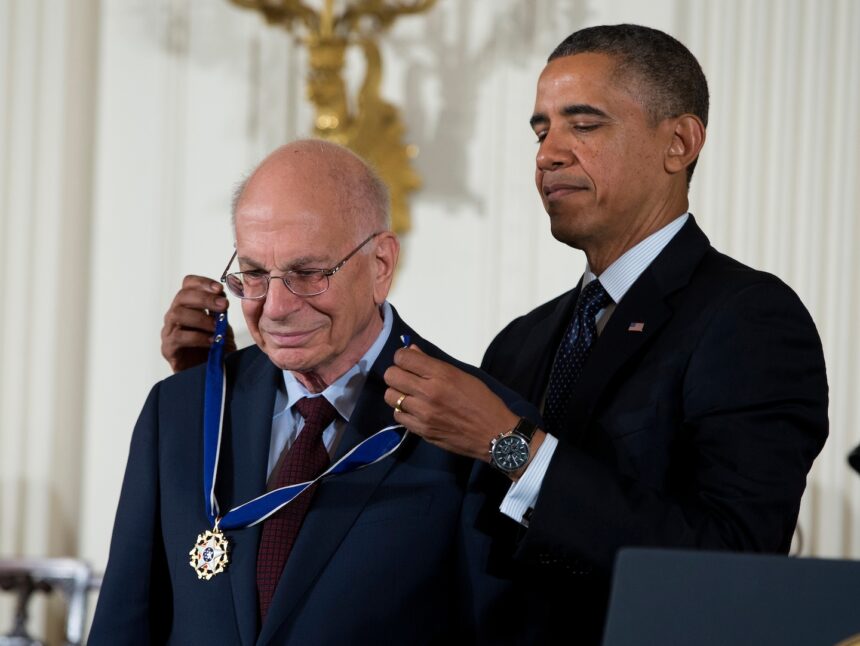
Dr. Kahneman received the Presidential Medal of Freedom, the nation’s highest civilian honor, from President Barack Obama in 2013. An inveterate pessimist, he said he and his wife had not expected the Nobel, despite a raft of honors received over the years.

“We thought the probability was 0.2,” Treisman told the Philadelphia Inquirer after Dr. Kahneman’s award was announced. “We were quite interested to see who won.”


You Might Also Like

School assembly news headlines today- September 9: Top national, sports and world news curated for you – India Today

Netanyahu’s Likud, Eisenkot’s Yashar end coalition talks without deal – Al Jazeera

Norway 2027 Women's (World Cup) Home Kit Leaked – Footy Headlines

Russell Brand’s wife vows to abide by prison rules after video controversy – The Guardian

Adidas 2026 World Cup 'Trionda' Official Match Ball Spotted for $15 – Footy Headlines

Sky Witness News Editorial Team March 27, 2024 March 27, 2024
Share This Article
Facebook Twitter Email Print
Previous Article Eb6362a1 F3a3 4f2f B1d3 62279386f414.png European Union is funding multiple Israeli drone projects
Next Article Top 10 Commercial Drone Companies.jpg Commercial Drone Companies | Best Tech Provided
Leave a comment

Leave a Reply Cancel reply

You must be logged in to post a comment.

Text To Speech

Stay Connected

Facebook Like
Twitter Follow
Pinterest Pin
Instagram Follow
Youtube Subscribe
- Advertisement -
Ad image

Latest News

Sky Witness News - Photo unavailableSky Witness News - Photo unavailable
School assembly news headlines today- September 9: Top national, sports and world news curated for you – India Today
Global News
Sky Witness News - Photo unavailableSky Witness News - Photo unavailable
Russia starts towing its ship hit by drones in Baltic, Finland says – South China Morning Post
Asia
Sky Witness News - Photo unavailableSky Witness News - Photo unavailable
EU Drone Projects: The Art of Doing a Lot, Yet Producing Nothing – sUAS News
Europe
Sky Witness News - Photo unavailableSky Witness News - Photo unavailable
Netanyahu’s Likud, Eisenkot’s Yashar end coalition talks without deal – Al Jazeera
Global News
//

Welcome to Sky Witness News, your premier source for comprehensive and unbiased news coverage spanning across Europe, South America, North America, Africa, and Asia.

//

Main Menu

  • Home
  • Europe
  • South America
  • North America
  • Africa
  • Asia
  • Global News
  • Talent Showcase

Quick Links

  • About Us
  • Contact Us
  • Privacy Policy
  • Terms and Conditions
  • Disclaimer

Sign Up for Our Newsletter

Subscribe to our newsletter to get our latest articles instantly!

Copyright ©️ 2024 Sky Witness News | All rights reserved.
  • About Us
  • Contact Us
  • Privacy Policy
  • Terms and Conditions
  • Disclaimer
Join Us!

Subscribe to our newsletter and never miss our latest Drone related news, podcasts etc..

Zero spam, Unsubscribe at any time.
Welcome Back!

Sign in to your account

Lost your password?