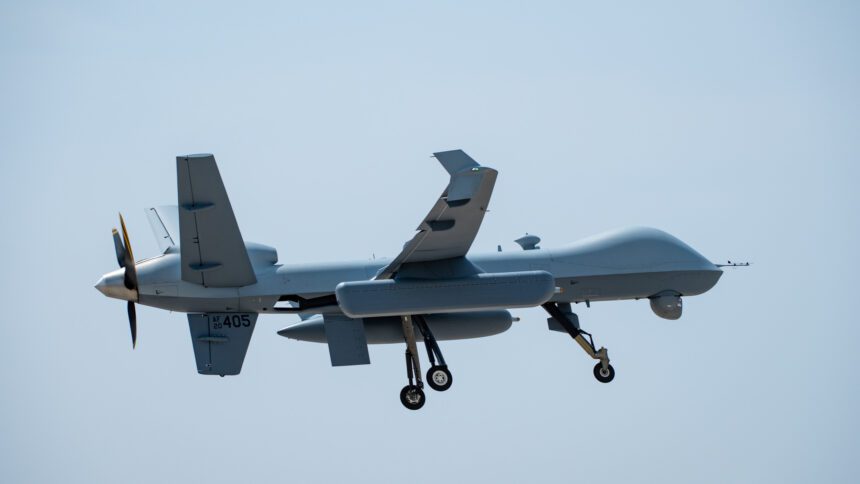
The largest American and allied air-power exercise on the Korean Peninsula, which last month drew strong words from North Korea, has featured its first live-fire drills with an MQ-9 Reaper, according to the U.S. Pacific Air Forces.
Declassified Air Force footage, taken during the recently concluded annual exercise known as Korea Flying Training, showed the remotely piloted unmanned aerial vehicle conducting live munitions training at the Pilsung Range in the mountainous terrain near South Korea‘s east coast.
1 of 2
U. S. Air Force/Staff Sgt. Samuel Earick
U. S. Air Force/Staff Sgt. Samuel Earick

U.S. Air Force/Staff Sgt. Samuel Earick
The Pacific Air Forces said the MQ-9 fired an inert GBU-12 Paveway II laser-guided bomb at a simulated target on April 19. The accompanying drone footage showed the projectile striking the desired mark on the ground. It was said to be the first such demonstration during the combined air exercises this year coordinated out of Kunsan Air Base in the east from April 12 to 26.
Among the most commonly used smart bombs, first seen in the Gulf War, the GBU-12 and its updated variants can also be fired from aircraft, including the B-52 Stratofortress, A-10 Thunderbolt II or “Warthog,” F-15E Strike Eagle, F/A-18 Hornet, B-1B Lancer, F-16C/D Fighting Falcon and F-35 Lightning II, according to the specialist Air & Space Forces Magazine.
The MQ-9 “was configured to participate in numerous training scenarios to rehearse its precision strike, close air support, and intelligence, surveillance and reconnaissance capabilities,” the Air Force said.
Around 28,500 U.S. troops are forward-deployed to South Korea as part of a decades-long effort to prevent aggression from the North. As the United States heads toward a major presidential election this fall, North Korea leader Kim Jong Un may feel emboldened to provoke a limited conflict in a bid to extract concessions, observers say.
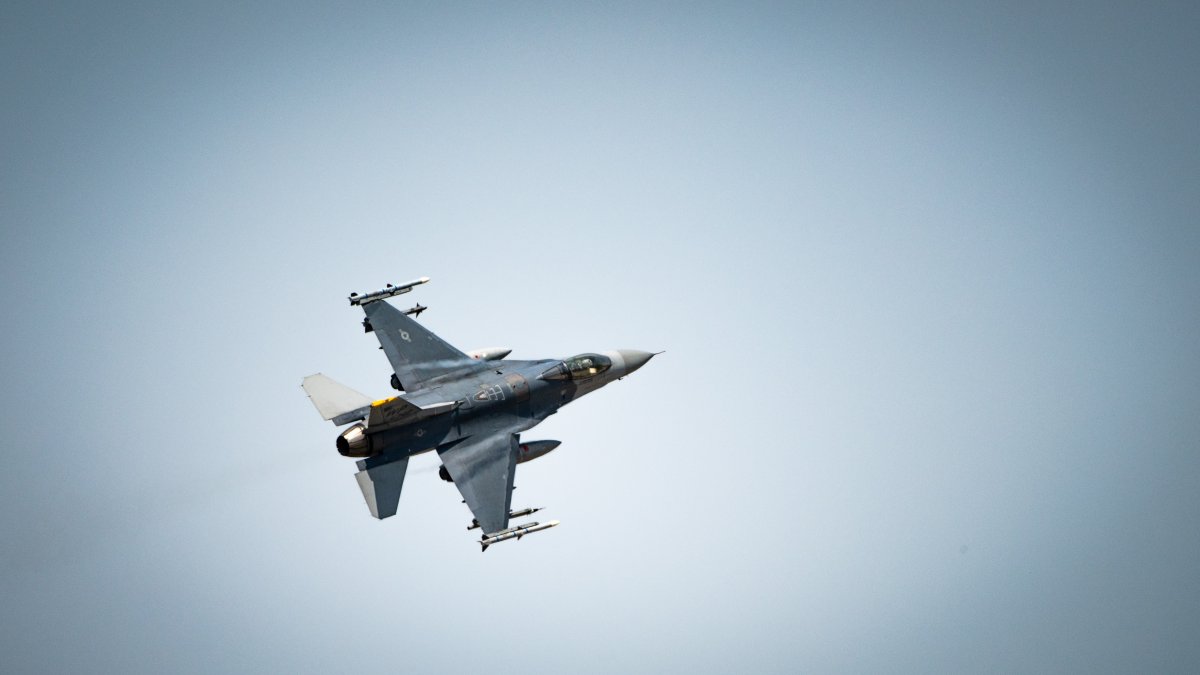
The U.S. Seventh Air Force, headquartered at Osan Air Base in South Korea, said this year’s expanded Korea Flying Training—involving nearly 20 different types of military aircraft—would include integrating fifth-generation capabilities from both countries. This would also involve “training mission commanders and aircrew to fly, flight and win in scenarios with robust surface-to-air and air-to-air threats.”
Last month, amid worsening inter-Korean relations, Kim Yo Jong, Kim Jong Un’s powerful sister, blamed the U.S. and South Korea for the deteriorating situation on the peninsula. In a statement carried by North Korea’s official Korean Central News Agency, the senior Workers’ Party official accused the allies of destabilizing “muscle-flexing.”
“We will continue to build up our overwhelming and most powerful military muscle to defend our sovereignty and security and regional peace,” Kim Yo Yong said.
U.S. Air Force/Staff Sgt. Samuel Earick
The Pacific Air Forces did not immediately respond to a written request for comment before publication.
In January, South Korea announced that production had begun on a domestically developed surveillance drone for its air force, a long-endurance unmanned system modeled on the capabilities of the MQ-9, which is manufactured by a unit of the U.S. defense contractor General Atomics. The project, nearly two decades in the making, will cost over $300 billion.
The following month, the U.S. approved India’s order of 31 MQ-9B SkyGuardian drones for its navy, army and air force—part of a package worth nearly $4 billion
U.S. Defense Secretary Lloyd Austin, at a House Armed Services Committee budget hearing on Tuesday, said Russia had turned to North Korea for artillery shells and missiles for use in the ongoing war in Ukraine.
“North Korea … is becoming more confident because of its affiliation with [Vladimir] Putin, so this is very concerning, something that we’re going to have to watch,” Austin said.
Russia vetoed a U.N. resolution in late March that would have extended an expert panel’s mandate to monitor the sanctions regime against North Korea for the country’s nuclear and ballistic missile tests.
The North Korean Embassy in Beijing and the Russian Foreign Ministry did not return multiple requests for comment.
Both Pyongyang and Moscow have denied trading arms.
Uncommon Knowledge
Newsweek is committed to challenging conventional wisdom and finding connections in the search for common ground.
Newsweek is committed to challenging conventional wisdom and finding connections in the search for common ground.