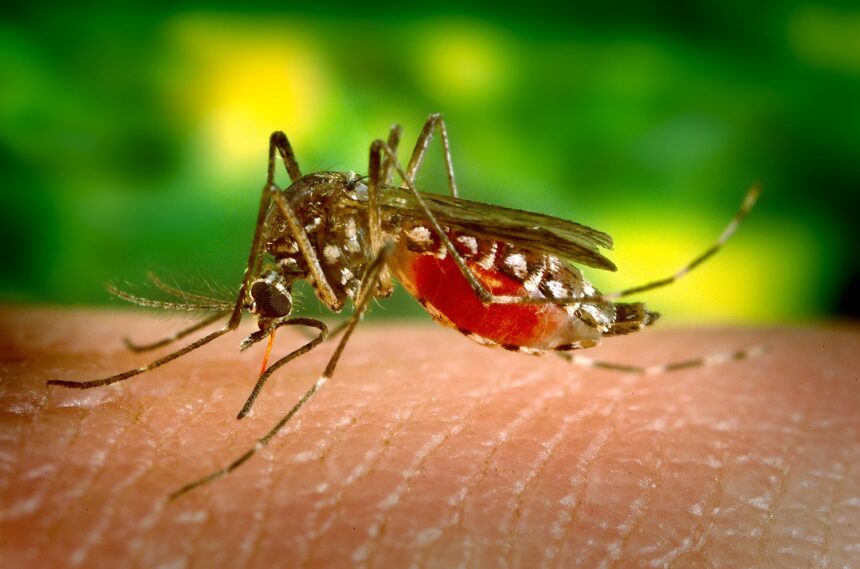

This photograph depicts a female Aedes aegypti mosquito, which is the primary vector for the spread of Dengue fever. This July, the World Health Organization warned that climate change could push dengue cases to near-record numbers. (Image credit: James Gathany/CDC)
The changing climate is dramatically altering the landscape of mosquito-borne diseases. Warmer temperatures, changes in rainfall, and human activity are enabling their spread to new places often unprepared to deal with them.
This year, locally transmitted malaria cases cropped up in Florida and Texas for the first time in 20 years. But dengue fever has dominated global headlines, with outbreaks unprecedented in their locations, severity, and duration. With deadly outbreaks from Bangladesh to Peru and record numbers of cases in Europe, the World Health Organization officials this July warned that climate change could push dengue cases to near-record numbers.
“Often people think that all mosquitoes are the same, or that all mosquitoes can transmit the same diseases, but in fact mosquitoes differ in their ecologies and their ability to transmit different pathogens, resulting in differences in how we prevent and mitigate disease transmission,” said Erin Mordecai, associate professor of biology in the School of Humanities and Sciences.
Mordecai is among several Stanford experts who are leading efforts to understand how climate change is impacting the spread of various mosquito vectors and the deadly diseases they carry – and how to respond. Educating communities and health providers about the differences between these various mosquitoes on the move is critical to protecting public health, they say.
Mordecai joined Desiree LaBeaud, professor of pediatrics at Stanford Medicine, Joelle Rosser, an infectious disease instructor, and Eloise Skinner, a senior scientist in the Mordecai Lab, to speak with the Stanford Center for Innovation in Global Health about how the burden of mosquito-borne disease is shifting, and how communities can prepare.
1. What worries you most about mosquito-borne diseases in light of rising temperatures and environmental changes?
LaBeaud: I worry about Aedes aegypti. These mosquito vectors spread a lot of diseases such as dengue, chikungunya, Zika virus, and yellow fever. Everything we’re doing as we alter our world puts us more at risk: They breed in the plastic waste we discard; they thrive in urban environments, and they like it hot. They’re also fairly sneaky. It’s hard to find them when they’re resting, so you don’t know where to spray. We’re also much less prepared for the diseases they spread, particularly dengue, than we are for malaria.
Mordecai: The biggest part of this story, in terms of numbers of cases and people affected, is probably dengue and the related viruses that are being transmitted by the same Aedes mosquitoes. If you look at the data on how they’ve changed over time, you see basically exponential growth in the last 30 years over almost every region where those diseases exist.
Skinner: Vector-borne diseases in general have been shaping humanity for centuries. So we expected outbreaks, but we didn’t necessarily expect the intensity we’re seeing now. Nor did we expect to see these vector-borne diseases like malaria, West Nile, and dengue, all with very different transmission cycles, hosts, and habitats, hitting different places at different times. Climate change is impacting all these multiple layers of the transmission cycle.