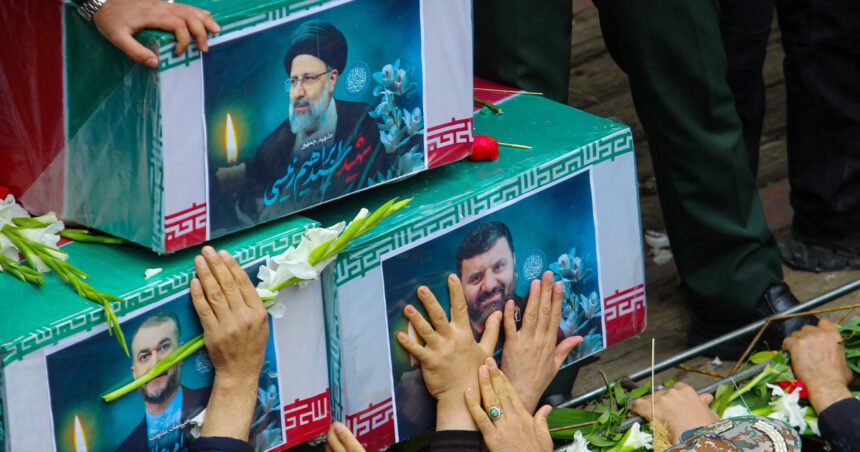
Wednesday will be a public holiday as a funeral for Raisi will be held in the capital, Tehran.
The ceremony is expected to feature high-ranking foreign dignitaries, the state news agency IRNA reported, but it was not clear yet how many would attend, given Iran’s status on the global stage. Russia, one of Iran’s closest allies, confirmed Tuesday that it would send the speaker of the state Duma, Vyacheslav Volodin. Neighboring Iraq said it would send its prime minister and Turkey said its vice president and foreign minister would attend.
Funerals will be held in two more cities Thursday. Raisi is expected to be laid to rest in the holy city of Mashhad on Friday.
His unexpected death led to scenes of mourning in Iran on Monday, as messages of condolences poured in.
But it was unclear whether Raisi’s death would draw public grieving on the scale of mass funerals like that for Gen. Qassem Soleimani, a top Iranian commander who was killed in a U.S. airstrike in 2020. The theocratic regime often uses such events as a display of national strength and unity.
Some expressed relief at the death of Raisi, 63, who was also known for presiding over brutal crackdowns on political opponents and protesters.
Laila, a 21-year-old student in Tehran, told the Reuters news agency that she was not saddened by the news, “because he ordered the crackdown on women for hijab.”
“But I am sad because, even with Raisi’s death, this regime will not change,” she said by phone.
Iran’s state media reported Monday that the country’s top prosecutor has already ordered action against those who publish “lies and insults” online about the crash that killed Raisi, after less-than-favorable comments about his death and legacy were shared on social media.
In a short statement late Monday, the State Department said the United States expressed its “official condolences” for the deaths of Raisi and the seven others killed. “As Iran selects a new president, we reaffirm our support for the Iranian people and their struggle for human rights and fundamental freedoms,” the statement added.
State Department spokesman Matthew Miller also said that the Iranian government had asked the U.S. for assistance in the aftermath of the crash. Washington agreed, Miller said, but ultimately was not able to provide it, largely for logistical reasons.
The United Nations Security Council, of which the U.S. is a permanent member, also held a moment of silence for Raisi on Monday.
But some European officials made clear their opposition to such acts.
“I don’t feel comfortable sending condolences while Iran is sending drones that are used against civilians in Ukraine,” Lithuanian Foreign Minister Gabrielius Landsbergis wrote on X.
Tehran has been accused by Ukraine and its Western allies of supplying Russia with drones and other weapons for its war. Both Iran and Russia deny these allegations.
The sentiment was echoed by British Security Minister Tom Tugendhat, who said he won’t mourn Raisi because his regime has “murdered thousands at home, and targeted people here in Britain and across Europe.”