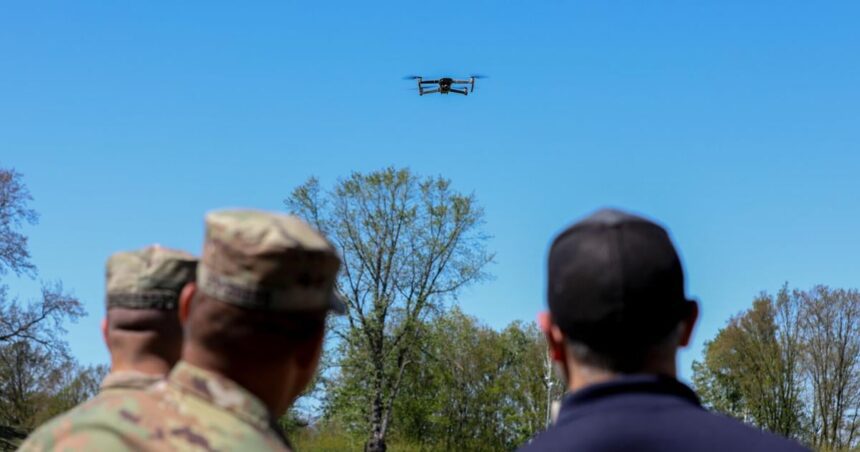
BOLESŁAWIEC, Poland — Picking up the Dronebuster, Spc. Edgar Galvan peers out into the open field waiting for the instructors to fly a practice drone. His eyes are locked onto the horizon, and his hand is steady on the trigger. The drone quickly picks up into the sky, and it darts towards Galvan. He points, shoots and the drone stalls.
The Dronebuster is a handheld, non-kinetic piece of equipment designed to counter hostile small unmanned aerial systems used against U.S. military forces and its allies. This is the first time the 1st Cavalry Division has operated this equipment in the European theatre.
Galvan, a 20-year-old Houston native with the Main Command Post Operational Detachment, 1st Cav. Div., Texas Army National Guard, has never used any kind of counter-drone equipment like the Dronebuster before. He has been in the Army for two years, serving as a geospatial intelligence imagery analyst.
“This is the first time I’ve heard about UAS, or unmanned aerial systems and the Dronebuster,” Galvan said. “I’ve never had any training for it.”
Together, Brien Conner, a mobile training specialist, and Chief Warrant Officer 4 Benjamin Richards, an air and missile defense systems integrator from Headquarters and Headquarters Battalion, 1st Cav. Div., developed a comprehensive program for Soldiers on how to operate the Dronebuster in real-time. Conner, a U.S. Army retired 1st sergeant, provides training for nearly all U.S. forces across the region.
“We’re trying to improve the capabilities and readiness of this unit in terms of being prepared for the drone threat that’s now prevalent on the battlefield,” Conner said. “The drone threat has completely changed. If the units are not preparing for that, we don’t want them to be caught off guard.”
Richards previously organized similar training in Fort Cavazos in the past year. He serves as the interface control officer, and frequently plans hands-on training for Soldiers.
“To get ahead and start training and educating our Soldiers on how to operate the Dronebuster or mitigate drone threats, I thought it was a good idea to reach out early on while we are still getting embedded within this region,” Richards said. “The Army is good at providing lessons and classes, but it’s really important for Soldiers to get a piece of equipment in hand and be able to apply it, as well as see how it works.”
The counter-drone training spanned across two days and consisted of classroom lessons in the morning and hands-on Dronebuster training outdoors in the afternoon with the instructors. Galvan, along with other Soldiers, practiced with the Dronebuster to see its capabilities as well as its limitations. After using the equipment, Galvan began to put his experience into perspective.
“Sitting through the training about the systems that are being used in this environment, it definitely feels like this training is very relevant to us right now because the enemy knows we are close by,” Galvan said. “When I first got hands on the equipment, it felt unreal.”
After the completion of the two-day training, Galvan realized the gravity of the situation and the importance of having the responsibility of knowing how to counter a drone at any given time.
“Just like the (rifle) range, everyone is a safety,” Galvan said. “Everyone here in this environment is a drone fighter. While it may not pertain to my job specifically, it is important to know how to use the Dronebuster because you never know when you’ll find yourself in that situation.”