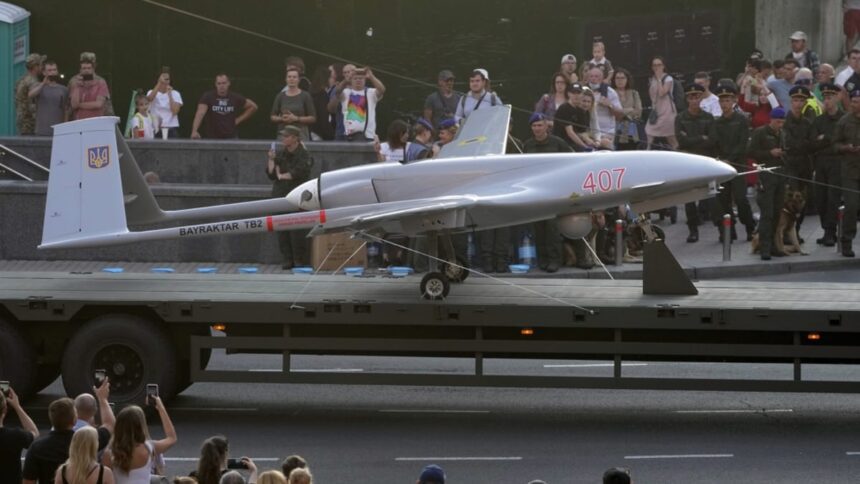
The TB2s, which can be armed with up to four laser-guided bombs or missiles, have even drawn blood against Russian invasion forces.
Not many videos of Ukrainian TB2 operations and attacks have been released, but the few that have been seen show them knocking out high value Russian targets.
Dutch OSINT researcher Stijn Mitzer, who keeps a running record of equipment losses on both sides during the war in Ukraine, has listed at least 20 Russian targets successfully struck by the TB2s. These include a train carrying fuel, multiple supply trucks and even the advanced Buk mobile surface-to-air missile, the same system that was believed to be responsible for shooting down Malaysian Airlines Flight MH17 in 2014.
Successful TB2 attacks against the Buk and Tor-M2 surface-to-air missile systems in Ukraine mean that the drone has carried on its string of recorded victories over Russian-built air defence systems that started in Syria, Libya and then against Armenian forces in the 2020 war over the enclave of Nagorno-Karabakh.
The Russians, for their part, have claimed to have brought down several TB2s although the video of only one wreck has been show so far.
EXPLOITING RADAR BLIND SPOTS
The relatively successful employment of the TB2, which Turkey is continuing to deliver to the Ukrainians following the Russian invasion, has surprised some observers like me who have previously questioned their survivability in airspace that is watched over by high-end anti-aircraft weapons.
Many reasons have been suggested for this success, including Russian air defence sensors like radars not being geared towards detecting smaller and slower targets, or the TB2 operators knowing and exploiting known radar blind spots.