

SINGAPORE: Tackling the oil spill that has struck several parts of Singapore’s coastline has been a challenge due to the ever-changing tides, said a senior executive at the Maritime and Port Authority of Singapore (MPA).
The spillage had occurred on the afternoon of Jun 14 at Pasir Panjang Terminal, after Netherlands-flagged dredger Vox Maxima hit a stationary Singapore-flagged bunker vessel Marine Honour, causing oil from the latter’s damaged cargo tank to spill into the water.
Speaking to the media during a visit to observe the agency’s clean-up efforts on Tuesday (Jun 18), Captain Chong Jia Chyuan, port master of MPA, said that following the incident, MPA immediately deployed its patrol craft to spray dispersants on the oil spill at the scene.
“Due to the current tides, some oil has landed on the southern coast of Singapore. Some of the challenges that we face is that the oil on sea is very mobile, it keeps moving due to the change of tidal currents,” he explained.
“The deployment of assets to collect this oil is a challenge. Hence, we use technologies such as drones and satellite images to keep track of the latest pictures of the movements of the oil.”
MPA had activated its oil spill response contractors in the aftermath, to collect the oil that had leaked out, and also deployed booms around the two vessels, said Capt Chong.
The two vessels currently remain anchored in the Western Anchorage amid ongoing investigations. The front of the Vox Maxima’s hull was observed to be black on Tuesday, coated in fuel oil from the Marine Honour, which has a gaping hole in its side from which 400 metric tonnes of fuel leaked into the sea.
Capt Chong said the immediate priority after the incident was to ensure that there were no further leaks into the sea from the damaged vessels, something which was achieved by Friday evening.
NEW ASSETS DEPLOYED
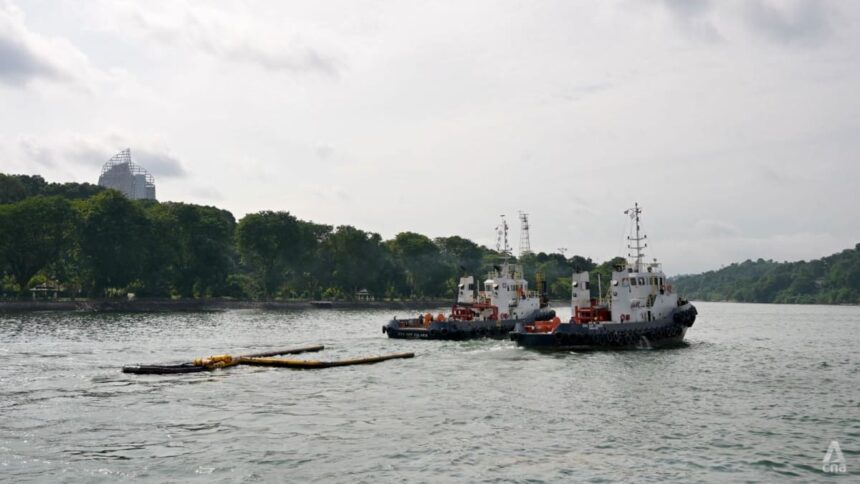
The MPA’s current arsenal of oil response assets deployed also includes Current Busters.
A Current Buster is a system that is designed to collect oil on the surface of the water. Towed by two vessels, it sweeps the water’s surface, funneling the oil towards an area where it is contained.

