- By Andrew Harding
- BBC News, Johannesburg
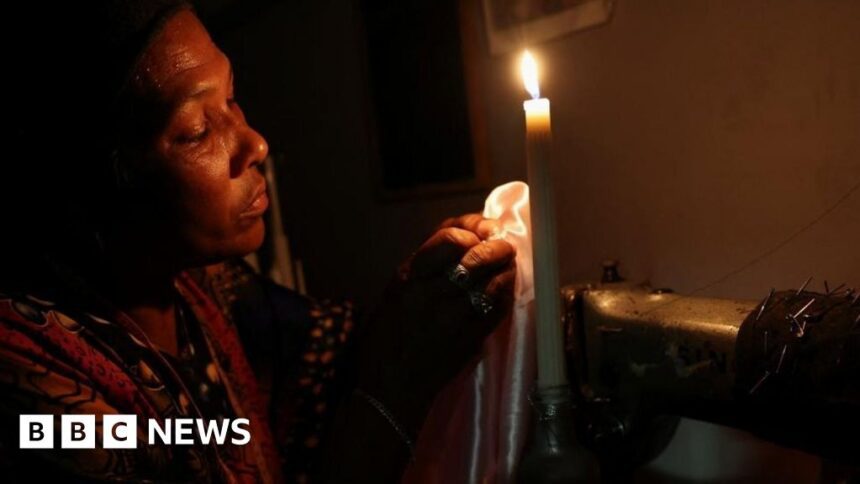
South Africa is heading into the southern hemisphere winter with the prospect of the country’s worst-ever power cuts – up to 16 hours a day. The roots of the problem lie in poor management, corruption and sabotage.
Late one Thursday afternoon, last November, a maintenance contractor reached his hand under a huge rotating shaft at an ageing power station in South Africa.
It took the man just a few seconds to unscrew a steel plug, smaller than a coffee mug.
As he moved away from the scene, precious lubrication oil quickly began seeping from the innards of the shaft. The steel bearings inside overheated and before long the coal mill, and with it one of the station’s eight turbines, ground to a sudden, and expensive, halt.
If you are looking to understand South Africa’s current struggles – its soaring crime and unemployment rates, its stubborn inequality and stagnant economy, its relentless corruption and crippling power cuts, and its broader drift towards what some fear could become “gangster state” or even “failed state” territory – then this one act of industrial sabotage, at a coal-fired power station on the high plains east of Johannesburg, is a good place to start.
The alleged saboteur, Simon Shongwe, 43, was working as a sub-contractor at Camden – a plant that was built back in the 1960s, bombed by anti-apartheid activists in the 1980s, mothballed in the 1990s, and more recently brought out of retirement to help a country now battling to keep the lights on.
There are several theories about the alleged sabotage.
It could have been designed to break the coal mill in order to enable a corrupt repair company to come and fix it at an inflated cost.
It might have been done as a way of threatening Camden’s management in to accepting some other corrupt contract.
Or it may have been part of a broader political conspiracy to damage South Africa’s energy infrastructure and undermine an ANC government increasingly seen as floundering after nearly three decades in power.
What is certain is that the sabotage at Unit 4 was not an isolated event.
Instead, it was one relatively small act in a vast, ongoing, and highly successful criminal enterprise that involves murders, poisoning, fires, cable theft, ruthless cartels and powerful politicians.
It is an enterprise that risks derailing international attempts to nudge South Africa away from its dependence on coal and towards renewable energy sources.
Over the past decade it has brought South Africa’s once-world-class public power utility, Eskom, to the brink of collapse and left most homes around the country in darkness for many hours each day.
Image source, Ed Habershon/BBC
South Africa relies on coal-fired power stations, some of which have been targeted by saboteurs
One month after the incident at Camden, on a secure floor of a large grey office block on the northern outskirts of Johannesburg, a much smaller machine was causing problems.
The coffee dispenser for the executive management team at Eskom was faulty. Or so it seemed.
When the CEO’s assistant came over to fill her boss’s personalised mug, there was a delay.
She left the mug unattended for a few minutes, and then, once the machine had been serviced, she returned to the CEO’s office with his coffee.
“I detected nothing. The foam consistency was a bit different to normal, but I thought nothing of it,” Andre de Ruyter reflected later, in an explosive interview he gave to the South African broadcaster, eNCA.
But 15 minutes later, the man in charge of South Africa’s power utility suddenly felt off-balance. Before long he was shaking violently, gasping for air, and “extremely nauseous”.
His security guards rushed him to a nearby clinic.
His doctors later confirmed that Mr De Ruyter had been poisoned with cyanide, possibly mixed with rat poison in order to mask the presence of the cyanide in any blood tests.
“So, this is where the executives serve themselves with coffee,” said Eskom’s head of security, Karen Pillay, showing us around the office one recent afternoon.
“I consider it a dangerous space. I’m still scared for my life, every day. Absolutely.”
So why would anyone go to such dramatic lengths to try to kill a man performing what, in most countries, would be considered an important, but hardly controversial job?
“There is a long list of those who want me dead,” said Mr De Ruyter, a tall man who recovered from the poisoning, quit his job at Eskom and left the country. He told me, via text, that he was “going to lie low for the moment”.
Mr De Ruyter made it clear he believed he had been targeted by powerful criminal cartels who were busy stealing “a billion rand ($52m; £42m) every month” from Eskom and its coal-fired power stations.
In his eNCA interview and in excerpts from a new book, he painted a vivid picture of sophisticated “mafia” gangs with dozens of well-trained “soldiers”, who were willing to kill anyone who threatened to clean up the coal industry, or to move towards renewable energy.
It is a picture that is immediately recognisable to many here.
“There’s a lot of killing around. They put a gun to my head. They came to my house and threatened my family. The whole system is rotten, corrupted,” said a local businessman who told us he had tried to supply parts to Eskom for years, but that the local cartels made it impossible to work honestly.
“These cartels are politically connected. They’re above the law, basically,” said the man, who asked us not to use his name for fear of being killed, and only agreed to speak to us at a secure location far from his hometown.
That request for anonymity is common in the province of Mpumalanga – the heart of South Africa’s coal industry and a province that has earned a reputation for extreme lawlessness.
‘Treasonous behaviour’
“Life is cheap here. You can hire a hitman for $400. People are just looting as much as they can,” said an investigative journalist working with us and South Africa’s Daily Maverick news website, who confirmed the businessman’s account.
“This is a brutal province for anyone trying to expose the truth. It’s sabotage at almost every stage of the process. And it’s not just about criminality. The money… gets passed on to politicians to keep them in power, to keep them running elections, to keep palms greased,” said the journalist, who also asked not to be named.
The ANC has been the governing party in Mpumulanga and nationwide since the country’s first democratic elections in 1994 after it successfully led the struggle against white-minority rule.
“This is treasonous behaviour. The ANC is involved at every level. The villains are members of the ANC or associates of the ANC. It is involved so deeply that it doesn’t know how to extricate itself. They are tipping us over towards that terrible situation of a ‘failed state,'” said political commentator Justice Malala, noting there was a direct link between the looting and the near-constant power cuts now crippling South Africa.
“It’s very depressing. It’s very concerning. Our country is in a serious, dark place,” said Paul Pretorius, a lawyer who played a key role at a recent public inquiry into the state corruption that flourished under former President Jacob Zuma.
As an indication of the seriousness of the crisis, soldiers have recently been brought in to guard some power stations, and to accompany convoys of trucks carrying coal, after the railway network was looted and sabotaged so comprehensively that many companies were obliged to switch to using South Africa’s roads.
Eskom security chief Ms Pillay said company investigators had recently identified more than 60 “black sites” where quality coal was still being stolen or swapped for rocky, poor-quality coal, by criminals.
Image source, Ed Habershon/BBC
Promise Mabilo is campaigning in Mpumulanga to make it a cleaner and safer place
In some places, the stealing is done in plain sight.
On the edge of the town of Emalahleni – which means “place of coal” – an allegedly illegal coal mine is in operation, around the clock, in a small valley just yards from a residential area. Over the course of one hour, we watched more than a dozen trucks load up with coal.
“At night we hear gunshots,” said a local activist who asked us not to use his name but described rival gangs fighting over access to the open-pit mine.
“It’s a dangerous business. You don’t know whether a mine is illegal or legal,” said one of the truck drivers, who said his name was Kamo.
A local community organisation – Vukani Environmental Movement (VEM) – has repeatedly taken South Africa’s government to court in a bid to force them to close down mining activity taking place close to residential areas.
“Nothing changes,” said Promise Mabilo, 48, a VEM coordinator, before bursting into tears.
“Emalahleni is not a safe place to be. The coal… is killing people. You can smell it and taste it in the air. It’s painful,” she said.
Crime and blackouts may dominate the headlines in South Africa, but pollution, particularly in Mpumalanga, is an equally dangerous by-product of the country’s addiction to coal.
The government has acknowledged pollution “hot spots” in the province but has declined to publish more detailed information and has refused to force old power stations to comply with emissions limits. Environmental groups say data shows the pollution is killing thousands of people every year.
Image source, Ed Habershon/BBC
Mbali Matsebula’s daughter Princess has to use a respirator to help her breathe
“She struggles to breathe. I have to blame the coal mines. They must cancel the coal because it is killing us,” said Mbali Matsebula, 27, as she helped her eight-year-old daughter, Princess, adjust a respirator on her face in the single-room shack they live in close to the illegal mine.
Today, more than 80% of South Africa’s electricity is generated by coal-fired power stations – an astonishing figure. As a result, the country is ranked as the world’s 14th largest emitter of carbon dioxide, despite having only the 33rd biggest economy.
“Our electricity system is almost entirely based on digging coal out of the ground and burning it,” acknowledged Crispian Olver, chair of the Presidential Climate Commission.
But that could be about to change. Perhaps dramatically.
A group of Western nations has agreed to an $8.5bn package of grants and loans known as the Just Energy Transition (JET) partnership, designed to help guide South Africa away from coal and towards renewables.
Under the terms of JET, the country could, in theory, achieve “net zero” carbon emissions by 2050, offering a blueprint for other developing nations looking to go green.
“Our wind and solar resources are amongst the best anywhere in the world,” said Mr Olver, enthusiastically.
South Africa has many reasons to embrace a speedy transition.
If it drags its feet, the country could soon find itself locked out of the global trading system, with at least half its exports blocked by new rules in Europe and elsewhere that will seek to ensure that goods are made using only, or mostly, green energy.
“If we don’t decarbonise, we’re going to be shut out… and we’re going to lose massive amounts of jobs,” warned Mr Olver.
Image source, Ed Habershon/BBC
Bar owner Suzeke Mousa says she could lose her business because of the lack of electricity
An even more urgent argument for change can be found in a small, gloomy bar in Alexandra, a poor township in the country’s commercial hub, Johannesburg.
“I’m so stressed. Very, very stressed,” said the bar owner, Suzeke Mousa, 50, explaining that her business was about to go under after 25 years.
“I don’t think we’ll survive. All because of Eskom,” she frowned, looking out across a dark and empty bar.
South African businesses, already hit by the pandemic, are now being forced to endure power cuts, sometimes for 10 or more hours a day, nationwide.
At major road junctions across the nation, unemployed and homeless men now earn a few rand from drivers in exchange for directing cars when the traffic lights are off.
The image of people in luxury vehicles tossing coins to beggars for helping them navigate the country’s failing infrastructure seems like a fitting metaphor for the current struggles facing this deeply unequal society.
“Some people can afford generators, but we can’t. We can’t function without power,” said Thelma Mokoena, working at a money-transfer bureau in Alexandra.
The “load shedding” – as it is known, euphemistically, here – is set to get worse over the winter months. There are warnings that the entire grid might even collapse – a scenario that could mean weeks of unremitting darkness and perhaps social unrest.
It is the inevitable result of the chaos inside Eskom, as its fleet of mostly aging power stations is hit by maintenance problems, sabotage, and corruption.
To many in the private sector here, South Africa’s abundant wind and solar potential offers an almost immediate solution for the crisis gripping Eskom. The former CEO, Mr De Ruyter, said it could “solve energy security in the shortest time”.
But there are many obstacles facing that transition. For a start, workers and unions here are concerned that there will be significant job losses.
“South Africa is going to lose jobs in the coal sector but not gain them in renewables. We are not going to be dictated to. You [in the West] are wasting your time. We are a country that must do things at our own pace,” said William Mabapa, secretary general of the powerful National Union of Mineworkers.
He condemned Western nations as “hypocrites” for pushing his country to embrace JET while still importing vast amounts of South African coal.
Eskom says it is working to address concerns about future job losses in local communities. But opposition to JET does not only come from within the coal industry.
In his eNCA interview, soon after his poisoning, Mr De Ruyter accused the ANC of deliberately blocking the move towards renewables.
He said the ANC used Eskom like “a feeding trough” and that powerful politicians were blocking his attempts to tackle corruption.
Mr De Ruyter cited a private intelligence dossier – shared with the BBC by investigative journalists from the Daily Maverick – that named two senior ANC politicians as the heads of two of Mpumalanga’s criminal cartels. And he said the government had brushed aside his concerns.
In an interview, South Africa’s Public Enterprises Minister Pravin Gordhan acknowledged that Mr De Ruyter had told him about the contents of the dossier.
Mr Gordhan also admitted that Mpumalanga was “a crime scene”. But he said Mr De Ruyter himself was no “angel” and criticised him for spreading rumours without producing hard evidence.
“I don’t think we’re that hopeless,” said Mr Gordhan, defensively, arguing that South Africa was moving towards renewable energy but needed to adjust the pace “to the reality of our country”. He later accused Mr De Ruyter of having a “messiah complex”.
Other ministers have taken an even tougher line.
If you are looking for a politician who embodies the current struggles and contradictions of South Africa’s governing ANC – the former liberation movement once led by Nelson Mandela – many people will point you towards Gwede Mantashe.
The irascible 67-year-old is a former miner and trade union official, a formidable labour organiser and former leader of South Africa’s Communist Party.
As secretary-general of the ANC, he spent years shielding President Zuma from corruption investigations, before backing the man who ousted him in 2018 – Cyril Ramaphosa.
President Ramaphosa then appointed Mr Mantashe as energy minister, the job he has held on to despite the deepening power-cuts and other controversies.
A few weeks before Mr De Ruyter’s poisoning, Mr Mantashe publicly accused Eskom’s leadership of treason. He said the utility, by allowing so many power cuts, was “actively agitating for the overthrow of the state”.
Sitting in the boardroom of his ministry in Pretoria, Mr Mantashe seemed to revel in his reputation both as a political survivor and the great curmudgeon of South African politics.
“They call me all sorts of things. A coal fundamentalist and a fossil fuel dinosaur. I take those as… a compliment. A prestigious status,” he said, with a small chuckle.
Mr Mantashe said the West was using South Africa, unfairly, as “a guinea pig” for radical energy reform without supplying sufficient funding.
He acknowledged a need to “phase down” the country’s coal dependency and acknowledged that reports of looting at Eskom “could be true”, but he brushed aside Mr De Ruyter’s poisoning as mere speculation, and stressed the economic necessity of getting the most out of existing coal power stations.
Some here believe the move towards renewables is now inevitable – that South Africa simply will not be able to access the sort of loans needed to keep its crumbling coal industry alive, and that the move towards solar, in particular, is now being firmly driven by the private sector.
“It’s unstoppable. I can confidently say the energy transition in this country is well under way,” said Mr Olver, from the Presidential Climate Commission. But progress is painfully slow and the struggle to clean up both Eskom and the broader economic and political climate in South Africa remains very much a work in progress.
On a cold morning, recently, in Ermelo, Mpumalanga, Simon Shongwe shuffled into the dock in a small, crowded courtroom.
It was a brief hearing to mark the transfer of his case to a new jurisdiction.
A full trial, on allegations that he sought to sabotage a turbine at Camden power station, could be months, or even years away. Mr Shongwe declined to speak to us, as did his lawyer. He has not yet entered a plea.
“We do see quite a number of arrests but unfortunately we may not have successful prosecutions,” remarked Ms Pillay, Eskom’s security chief.
Most of those arrests have targeted minor figures while the alleged kingpins appear to be protected by a culture of impunity and by a prosecution service still struggling to recover from years of politicisation and underfunding.
The two men suspected of poisoning the former Eskom boss’s coffee have not yet been found, let alone charged.