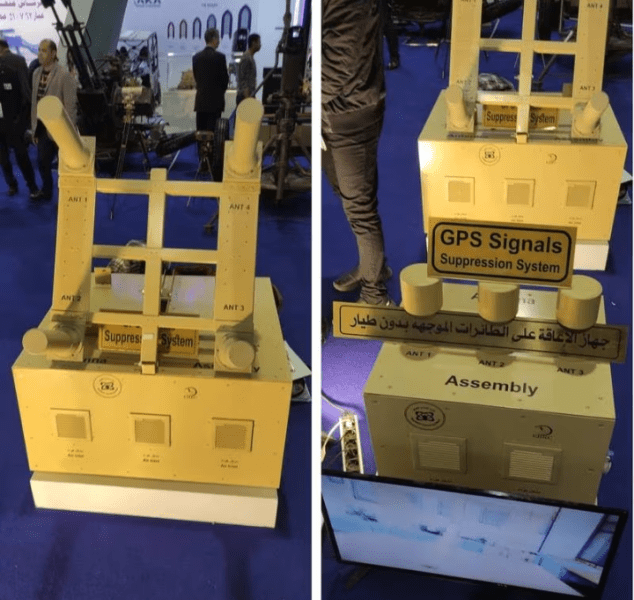
Egypt is demonstrating its capabilities in countering the emerging threat of drones at the Egypt Defence Expo (EDEX) 2023, which is held in Cairo from December 4 to 7. The country has unveiled its DJ-400 counter-drone system, which jams mini- and micro-UAVs from up to 4 kilometers away, and Guardian anti-drone system family for countering drones.
DJ-400 counter-drone system
The DJ-400 system is developed by the Arab Organization for Industrialization, a state-owned enterprise that produces various military and civilian products. The system was first displayed at the previous edition of EDEX in 2021, and is expected to enter service with the Egyptian military soon.
The system consists of two main components: the DJ-400V vehicle-mounted anti-drone jammer, and the DJ-400P portable anti-drone jammer. Both devices use digital frequency synthesizer and power amplifiers based on gallium nitride transistor technology to block the signals related to the remote control, data transfer and navigation of drones.


The DJ-400V can cover a 360-degree horizontal and 30-degree vertical area, and can be customized to provide sectoral protection according to the user’s needs. The device can jam drones within a range of up to 4 kilometers using a non-directed antenna, making it effective against swarm attacks from all directions. The device is also equipped with advanced control and protection circuits that monitor and display various operational conditions, ensuring optimal performance and safety.
The DJ-400P is a compact and lightweight device that can be carried in a backpack or a suitcase. The device can jam drones within a range of up to 2 kilometers using a directional antenna, making it suitable for rapid deployment and mobility. The device can also be integrated with a passive radar station to enhance the detection and identification of drones.
The DJ-400 system is designed to operate in all weather conditions, with an operational temperature range of -10 to +55 degrees Celsius. The system is ideal for protecting critical facilities and VIPs, as well as ensuring the security of high-profile events, such as conferences and inaugurations, where the risk of drone attacks is high.
The DJ-400 system is not the only anti-drone solution that Egypt is interested in. The country has also signed a cooperation agreement with Russia to produce the Zashchita (Protection) civilian anti-drone system, which was developed by the Vector Research Institute, part of Ruselectronics holding within Russia’s state technological company Rostec.
The Zashchita system is similar to the DJ-400 system in that it uses passive radar and radio monitoring equipment to detect, identify, track and jam drones. However, the Zashchita system also has a suppression complex that can disrupt the communication channel between the drone and the operator, as well as the passive coherent location radar that makes the system invisible to enemy interceptors.
The agreement between Egypt and Russia is the first of its kind since the cancellation of the sale of Su-35 fighter jets under the threat of US sanctions. Rostec has emphasized that the agreement is in the civilian sphere and does not violate any international obligations. The agreement aims to increase the production volumes and promote the anti-drone means developed by the Vector Research Institute in Africa, where the demand for such systems is growing.
Egypt is also showcasing its achievements in developing and manufacturing anti-drone systems at the Egypt Defence Expo (EDEX) 2023, which is held in Cairo from December 4 to 7. The country has introduced its Guardian system family for countering drones, which was developed by the Arab Organization for Industrialization in partnership with the Armed Forces.


The Guardian system family consists of five variants, each designed for a specific mission and platform. The systems use a combination of radar, electro-optical, and jamming technologies to detect, identify, track, and neutralize small and micro unmanned aerial vehicles (UAVs) that pose a threat to critical facilities and personnel.
The Guardian 1 system is mounted on a van and has a three-dimensional radar with a range of up to 7 km. The system monitors and identifies the target by radar and then confirms it using the electro-optical monitoring system, which has a range of 1 km. The system has jamming capabilities on GNSS systems with a range of up to 5 km and 360 degree coverage. It is also equipped with a GPS-guided jamming platform with a range of up to 1.5 km, and jamming capabilities on data links with a range of 4 km in different frequency bands.
The Guardian 2 system is installed on the Fahd armored personnel carrier and has a two-dimensional radar with a range of up to 5 km. The system confirms and distinguishes the target using the electro-optical monitoring system, and then chooses the appropriate means of confrontation, whether they are kinetic or non-kinetic. The system is integrated with jamming systems for navigation, control, and data communications systems, as well as a remote weapon station that can be armed with machine guns of different calibers and can deal with targets at low altitudes.
The Guardian 3 system is installed on the Egyptian-made ST-500 light armored vehicle and has a two-dimensional radar with a range of up to 5 km. The system confirms and distinguishes the target using the electro-optical monitoring system, and then chooses the appropriate means of confrontation, whether they are kinetic or non-kinetic. The system is also equipped with a locally made remote weapon station for a 12.7 mm machine gun that can deal with targets at low altitudes, and integrated with it are guided jamming systems for navigation, control, and data communications systems.
The Guardian 4 system is an integrated system of detection and counter-measures for small and ultra-small drones. It is designed to detect radar- and electronically-guided drones, confirm and distinguish targets using an integrated electro-optical system, and then choose the appropriate counter-measure from a number of kinetic or non-kinetic options. The detection and confrontation means are integrated through a command center that allows its systems to work in harmony to detect and confront UAVs. The system is similar in its capabilities to the Guardian 2 and 3 systems, with the difference in the capabilities of the electro-optical monitoring system.
The Guardian 5 system is a compact system carried by individuals, designed to detect radar- and electronically guided drones, confirm and distinguish targets using an electro-optical system, and then use guided jamming as a means of confrontation. It is mounted on a tripod that is easy to transport by individuals, and the electro-optical monitoring range reaches 1 km, while the system has a guided jamming gun with a range of 1.5 km.

The Guardian system family reflects Egypt’s efforts to develop and produce its own anti-drone solutions, in line with its vision of enhancing its national security and technological capabilities. The systems are expected to enter service with the Egyptian military soon, and may also attract interest from other countries in the region and beyond. The presentation of these systems at the EDEX 2023 is a testament to the progress and innovation in the Egyptian defence industry.
The EDEX 2023 is the third edition of the biennial defence exhibition that showcases the latest military and security technologies from around the world. The event attracts over 400 exhibitors and 30,000 visitors from more than 60 countries. The exhibition also features live demonstrations, seminars and conferences on various topics related to the defence industry.