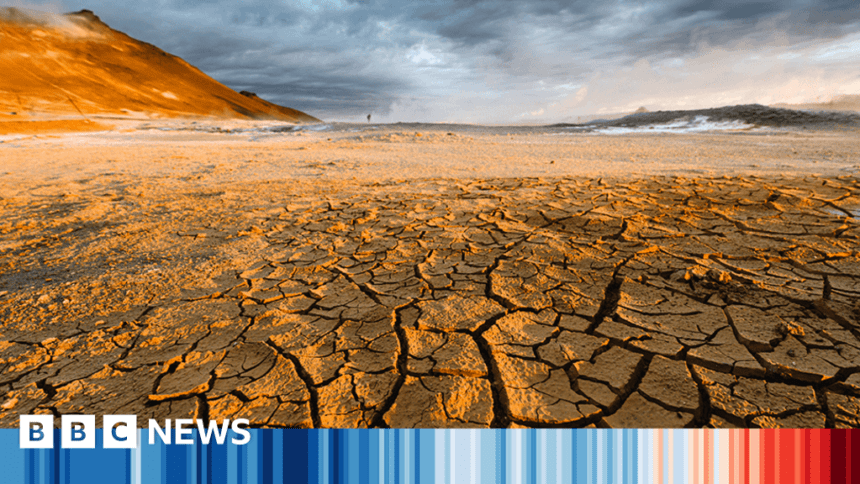
Image source, Getty Images
Global temperatures are rising because of human activity, leading to more intense heatwaves and rising sea-levels.
Things are likely to worsen in the coming decades, but scientists argue urgent action can limit the worst effects of climate change.
What is climate change?
Climate change is the long-term shift in the Earth’s average temperatures and weather conditions.
Are humans causing climate change?
The climate has changed throughout the Earth’s history. But natural causes cannot explain the particularly rapid warming seen in the last century.
When fossil fuels burn, they release greenhouse gases – mostly carbon dioxide (CO2). This traps extra energy in the atmosphere near the Earth’s surface, causing the planet to heat up.
What are the effects of climate change so far?
A global average temperature increase of 1.1C might not sound much.
However, it has already had a huge effect on the environment, including:
People’s lives are also changing.
How will future climate change affect the world?
The more temperatures increase, the worse the impacts of climate change become.
- Extreme hot days would be on average 4C warmer at mid-latitudes (regions outside the poles and tropics), versus 3C at 1.5C
- Sea-level rise would be 0.1m higher than at 1.5C, exposing up to 10 million more people to events including more frequent flooding
- More than 99% of coral reefs would be lost, compared with 70-90% at 1.5C
- Twice the number of plants and vertebrates (animals with a backbone) would be exposed to unsuitable climate conditions across more than half the geographical area where they are found
- Several hundred million more people may be exposed to climate-related risks and susceptible to poverty by 2050 than at 1.5C.
The call to limit temperature rise to 1.5C was partly designed to avoid crossing so-called “tipping points“.
After these, changes could accelerate and become irreversible, such as the collapse of the Greenland Ice Sheet. However, it’s not clear precisely where these thresholds sit.
About 3.3 to 3.6 billion people are highly vulnerable to climate change, according to the IPCC.
People living in poorer countries are expected to suffer most as they have fewer resources to adapt.
However, knock-on impacts could be felt over wide areas. For example, crop failures linked to extreme weather could raise global food prices.
What are governments doing about climate change?
To achieve this, “net zero” CO2 emissions should be reached by 2050. Net zero means reducing greenhouse gas emissions as much as possible, and removing any remaining emissions from the atmosphere.
World leaders meet every year to discuss their climate commitments.
The most recent UN climate change summit, COP28, was held in the United Arab Emirates. For the first time, countries agreed to “contribute” to “transitioning away from fossil fuels”, although they are not forced to take action.
The next conference, COP29, is set to be held in Azerbaijan in November 2024.
What can individuals do?
Top image from Getty Images. Climate stripes visualisation courtesy of Prof Ed Hawkins and University of Reading.