

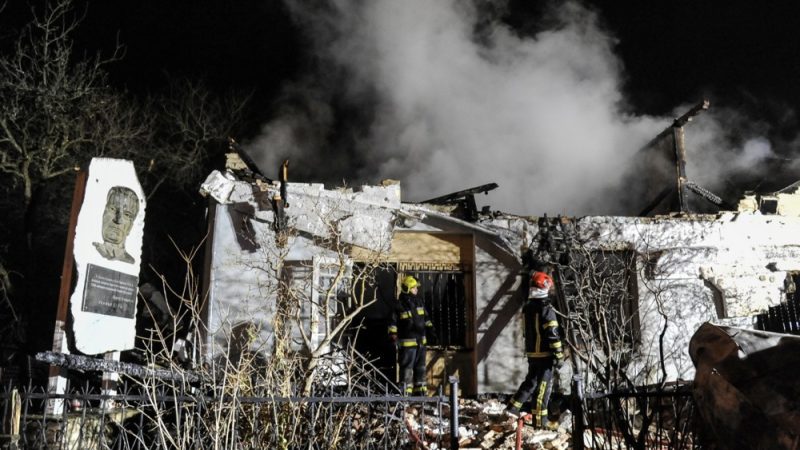
Russian drones attacked a university and a museum linked to two of the most prominent 20th century defenders of Ukrainian national identity on Monday (1 January), leaving locals vowing to repair the damage.
The first smashed windows and much of the roof at the National Agrarian University, outside the western Ukrainian city of Lviv, where Stepan Bandera – a hero in Ukraine but a villain according to the Kremlin – studied.
It hit on what would have been Bandera’s 115th birthday.
The second ravaged a nearby museum devoted to Roman Shukhevych.
Both men were key figures in nationalist resistance to Soviet rule and were associated with the Ukrainian Insurgent Army (UPA) which fought Soviet forces in World War Two.
“This is the building in which Stepan Bandera attended classes. There’s a memorial plaque dedicated to Bandera, and the statue too,” 82-year-old Sofia Zdorovyk said as people cleared up the rubble around her.
“Everything that’s been going on in our country, for so many years, do they (Russia) feel better because of it? Don’t they have enough land? Natural resources? What is it that they need?”
Lviv Mayor Andriy Sadovyi described the strike on the museum as a symbolic act. “We will restore it after our victory,” he said.
Bandera was the most prominent figure in a group associated with the UPA, whose ranks swelled to 100,000 by 1944, according to historical accounts, and continued fighting Moscow’s rule until the mid-1950s. Shukhevych was the UPA’s supreme commander.
Moscow still invokes Bandera’s name to underpin its assertions that it invaded Ukraine in February 2022 to “denazify” the country, pointing to the fact that some nationalists initially cooperated with German forces in their battle against the Russians – though they later also fought the Nazis.
“Just hearing the name Bandera scares them (the Russians). It causes rage and hatred,” Vasyl Lapushniak, President of the Lviv National Agrarian University, said. “They did not scare us with this. It only united us once more and showed our strength.”
The honour of “Hero of Ukraine” was bestowed on both men in the post-Soviet period. Soldiers from the UPA’s ranks were declared “veterans” alongside Soviet Red Army soldiers.
The nationalist army’s activity has long been clouded by allegations that it carried out massacres of tens of thousands of ethnic Poles in western Ukraine’s Volyn region – part of an area that was under Polish rule between the two world wars.
Poland and Ukraine have taken measures to honour those deaths and seal a reconciliation between the two neighbours.
Zelenskyy says Russia suffered severe losses
Ukrainian President Volodymyr Zelenskyy said Russian forces are suffering heavy losses and the notion that Moscow is winning the nearly two-year-old war is only a “feeling” not based on reality.
“Thousands, thousands of killed Russian soldiers, nobody even took them away,” he told The Economist magazine in an interview published on Monday, referring to fighting around the besieged eastern town of Avdiivka which he visited last week.
He provided no evidence to back up his assertion, but Western military analysts agree Russia is paying a heavy price in men and equipment for relatively minor gains in eastern and southern Ukraine.
There was no response to a request for comment from Russian officials on Zelenskyy’s remarks.
Russian officials have said Western estimates of Russian death tolls are vastly exaggerated and almost always underestimate Ukrainian losses.
Russian President Vladimir Putin said last month Russia’s position was improving and it would not stop what he calls the “special military operation” until its objectives, including Ukraine’s “denazification, demilitarisation and its neutral status”, have been achieved.
Russian officials have dismissed as a failure a Ukrainian counteroffensive launched in mid-2023 in the east and south.
Zelenskyy acknowledged that the counteroffensive backed by advanced Western weapons may not have succeeded “as the world wanted. Maybe not everything is as fast as someone imagined.”
In contrast, he hailed the “huge result” of Ukrainian forces breaking through a Russian Black Sea blockade, enabling grain exports by way of a new route along its southern coast.
If Ukraine lost the war, he said, Russia would be encouraged to advance against other countries because “Putin feels weakness like an animal, because he is an animal. He senses blood, he senses his strength.”
Mobilising Ukraine and the world
With support for Ukraine facing obstacles in the United States and European Union, more needed to be done to persuade the world that defending Ukraine meant defending the world, Zelenskyy said.
“Maybe something is missing. Or maybe someone is missing,” he told the magazine. “Someone who can talk about Ukraine as a defence of all of us.”
Zelenskyy acknowledged that “mobilisation of Ukrainian society and of the world” that was so strong at the start of Russia’s invasion is not there anymore.
Ukraine saw tens of thousands of men volunteer to fight in the first months of Russia’s invasion, but that enthusiasm has waned 22 months later.
“That needs to change,” he said. “Mobilisation is not just a matter of soldiers going to the front. It is about all of us. It is the mobilisation of all efforts. This is the only way to protect our state and de-occupy our land.”
Zelenskyy has embarked on a flurry of international trips trying to shore up Western support. At home, he has repeatedly urged Ukrainians to do their duty.
A draft law that proposed lowering the mobilisation age to 25 from 27 has sparked controversy.
Russia has said it is ready for peace talks if Ukraine takes account of “new realities”, suggesting an acknowledgement that Russia controls about 17.5% of Ukrainian territory.
Zelenskyy rejected any notion that Moscow was interested in talks, pointing to its repeated waves of aerial strikes. Russia would only agree to a pause in fighting if it needed a break to replenish its army, he said.

