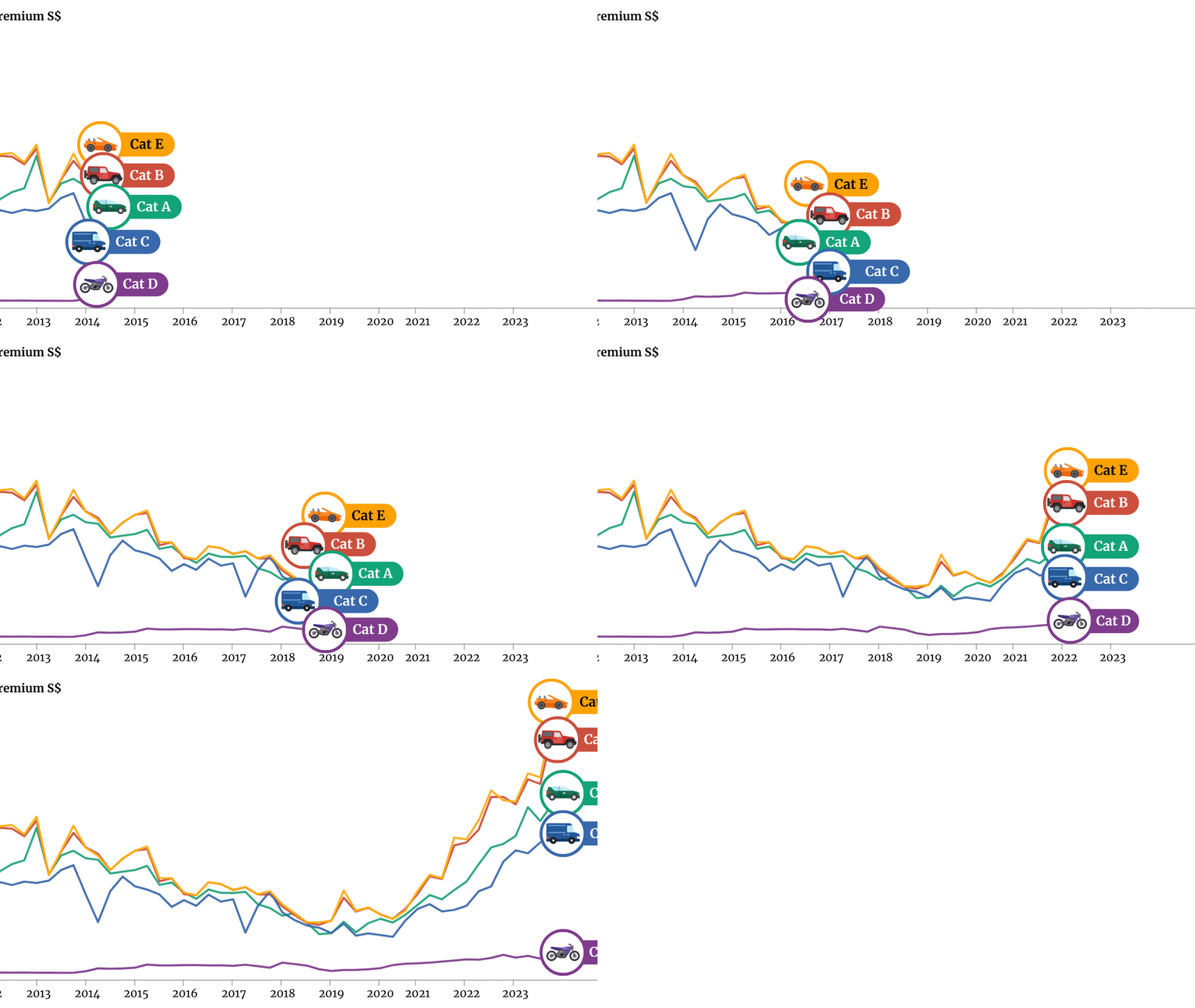
We do not know whether these cars are being used for private hire, car sharing, or private purposes, transport economist Walter Theseira told CNA. This lack of information makes it difficult to determine whether COE demand can be linked to private-hire companies and their fleets, added the associate professor at the Singapore University of Social Sciences (SUSS).
Data from the Transport Ministry shows the total private-hire car population stands around 78,000, with two-thirds being chauffeured PHCs such as those from ride-hailing companies. The remaining self-drive PHCS include car-sharing vehicles. Both are available for rentals, but only chauffeured PHCs may be used to provide ride-hail services.
Yet, the data does not capture how the vehicles are used in order for demand to be assessed.
Additionally, Singapore Institute of Technology’s (SIT) Zhou Yi said private-hire companies are not always the owners of the PHVs, making it difficult to prevent abuse should a new COE category be created. “Remember, the ‘Uber’ model is a large point-to-point transport without owning any car,” Assoc Professor Zhou said.
He added: “Everyone can go for the PHV category unless the government sets similar KPIs [as it does] for taxi owners.”
Addressing this suggestion in parliament, Mr Chee said there are “trade-offs” to having a separate COE category for car-leasing companies including a risk of further spikes in the prices due to fewer certificates in the market. He added the government would study the possibility of “further options beyond COE bidding” to address these concerns with car-leasing companies.