KINGSTOWN, St. Vincent (AP) — The small South American nation of Guyana said it refuses to bow to its larger neighbor Venezuela Thursday before the two countries met in the latest chapter of a bitter dispute over an oil- and mineral-rich territory claimed by both.
Who controls Essequibo, a vast border region located along Venezuela’s border “is not up for discussion, negotiation or deliberation,” Guyana’s government said.
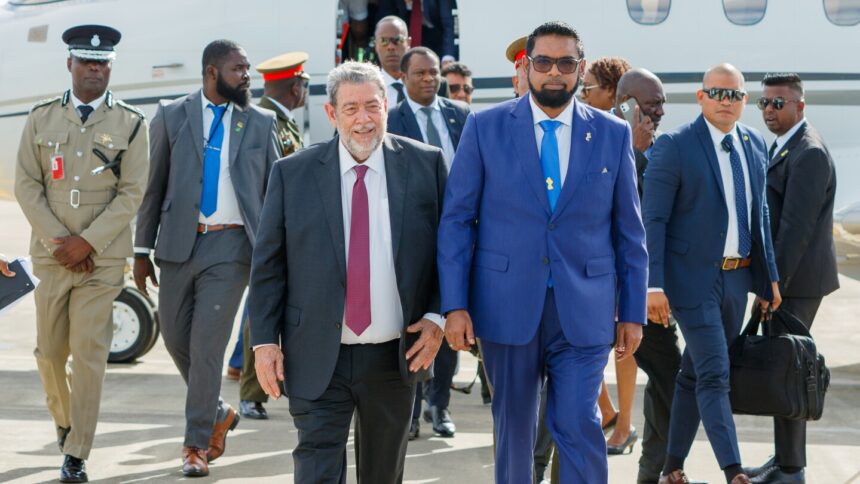
The statement was issued shortly before Guyanese President Irfaan Ali and Venezuelan President Nicolás Maduro met on the eastern Caribbean island of St. Vincent. They clasped hands before sitting down to talk behind closed doors as leaders around them clapped.
Maduro said ahead of the meeting that, “we will make the most of it so that our Latin America and the Caribbean remains a zone of peace.”
The tension over Essequibo has raised worries about a military conflict, even though many believe that unlikely.
White House National Security Council spokesman John Kirby said Thursday that Biden administration officials were closely monitoring the rising tensions between Venezuela and Guyana over Essequibo.
“We don’t want to see this come to blows,” Kirby said. “There’s no reason for it to and our diplomats are engaged in real time.”
The dispute over Essequibo escalated when Venezuela reported that its citizens had voted in a Dec. 3 referendum to claim two-thirds of their smaller neighbor.
Ali and Maduro first met individually Thursday with prime ministers and other officials from the region who had pushed for the meeting at the Argyle International Airport on St. Vincent. Guyana’s government has said that it is awaiting a ruling from the International Court of Justice in The Netherlands and in its statement Thursday said that regional leaders “concurred with Guyana‘s position.”
Leaders were meeting behind closed doors later Thursday and could not be immediately reached for comment.
But ahead of the meeting, Ralph Gonsalves, prime minister of St. Vincent and the Grenadines, said that “to use a cricket metaphor, this is not a one-day cricket match.”
“The fact that they will be talking is very important on friendly, neutral grounds like St. Vincent and the Grenadines,” he said
Venezuela’s president has ordered state-owned companies to explore and exploit the oil, gas and mines in Essequibo. And both sides have put their militaries on alert.
Venezuela insists the Essequibo region was part of its territory during the Spanish colonial period, and argues the 1966 Geneva Agreement between their country, Britain and Guyana — a former colony called British Guiana — nullified the border drawn in 1899 by international arbitrators.
Ali rejected what he said Maduro was description of “meddling of the United States Southern Command, which has begun operations in the disputed territory.”
The U.S. Southern Command conducted flight operations within Guyana in recent days.
“Any allegation that a military operation aimed at Venezuela exists in any part of Guyanese territory is false, misleading and provocative,” Ali said in a letter to Gonsalves ahead of the meeting.
A letter from Maduro to Gonsalves repeated Venezuela’s contention that the border drawn in 1899 was “the result of a scheme” between the U.S. and the U.K. It also said the dispute “must be amicably resolved in a matter acceptable to both parties.”
____
Follow AP’s coverage of Latin America and the Caribbean at https://apnews.com/hub/latin-america