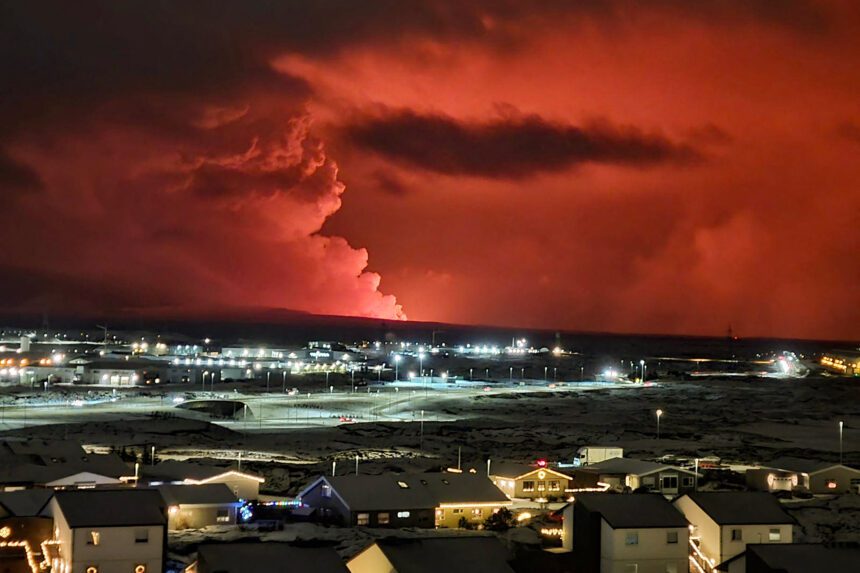
REYKJAVIK, Iceland — A volcanic eruption lit up the sky over Iceland Monday night, creating a 2.5 mile fissure that has sent a river of lava flowing toward surrounding towns.
Police declared a state of emergency and tourists spots were closed as hundreds of cubic meters of lava spewed across the Reykjanes peninsula. The eruption took place in the southwest of the island, near to the Keflavik International Airport, the capital city of Reykjavik and country’s famous thermal springs.
The long-awaited eruption was finally recorded at 10:17 p.m. (5:17 p.m. ET), said the Icelandic Meteorological Office, which has closely monitored seismic activity in the area for weeks.
More than 3,400 people in the small fishing town of Grindavík, 1.8 miles from the southern end of the fissure, were evacuated in November after it was hit by earthquakes and large cracks issuing plumes of steam appeared in roads.
The U.S Embassy in Reykjavik advised Americans to avoid the area surrounding the eruption and monitor local media for information and guidance.
Webcams showing live images of the eruption showed white-hot bubbling pools of churning lava Tuesday morning.
“This eruption is more powerful than three former eruptions in that area and it happened unusually fast,” Freysteinn Sigmundsson, a geophysicist at the University of Iceland, told NBC News. “Pressure was enough to break the crust rapidly.”
“The lava flow on the ground is still in a remote area, so at this point it’s not an immediate threat to the town Grindavík or the powerplant Svartsengi. But there can still be a risk of lava flow damaging infrastructure,” he said.
The country’s meteorological office said there was “significant ground disruption” from the eruption, which could last as long as 10 days, but the intensity of the eruption was already decreasing early Tuesday.
Iceland’s civil defense coordination center has been activated as a precaution, and police raised the nation’s civil defense preparedness level, according to a statement from civil defense officials.
Authorities asked the public not to visit the area of the volcano.
While some nearby population centers have been evacuated, there have been fears that an eruption could send lava towards power plants, but experts said this was now unlikely.
“If everything is normal, this will subside in the afternoon tomorrow, the crack will begin to retreat into craters. The eruption could last a week to 10 days,” Ármann Höskuldsson, a volcanologist, told RUV, Iceland’s public broadcaster, Monday night.
However, others warned that the direction of the lava flow could quickly change.
Asked where the lava could flow early Tuesday, Volcanologist Þorvaldur Þórðarson told RUV: “That’s a good question — it could go close to major infrastructure in a relatively short period of time.”
He said that defenses that had been built near the Svartsengi power plant and the Blue Lagoon, a popular spa destination currently closed to visitors, would “hopefully prove to be good for us,” while adding that lava has been flowing up 0.6 miles per hour.
The lava flow could move towards Reykjanesbraut, a major road running east to west along the peninsula, and the small village of Vogar, “so we have two urban areas that are in a certain danger,” he said.
Keflavik Airport remains open for business, with flights arriving and leaving, but departure boards showed there were several delays. Monday’s eruption differs from the Eyjafjallajökull volcano eruption in 2010, when hot magma met a glacier and sent hot ash miles into the sky, causing delays and cancelations for millions of air travelers.
The Icelandic meteorological office said it would monitor the situation and convene a meeting of scientists to evaluate the overnight developments. The Icelandic cabinet is due also due to meet Tuesday morning.
Björg Magnúsdóttir reported from Reykjavik, Iceland; Dennis Romero reported from Los Angeles; Patrick Smith reported from London.