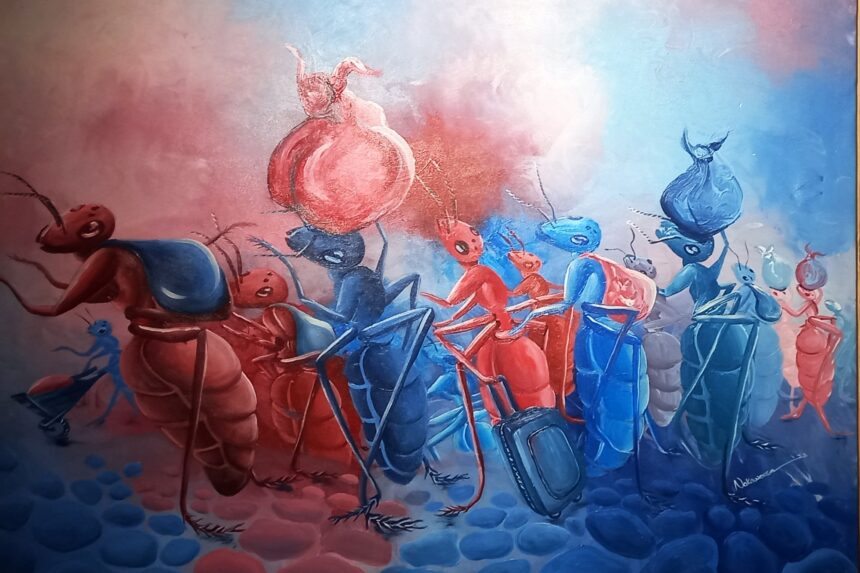
A Ugandan artist is using a solo exhibition at the Nommo Gallery in Kampala to interrogate the cultural clash between the values of African traditional society on the one hand and those that were introduced by colonialism on the other.
Rebecca Angellah Nakaweesa in her debut solo exhibition titled The Curious World of Humans is displaying a collection of 29 skilfully rendered paintings. Nakaweesa told Saturday Monitor that she is seeking to trigger interrogations deep into narratives beneath the notion of cultural identity as a solution to the historical identity crisis faced by African communities in the midst of decolonial discourses.
The artist displays creative mastery of the subject with the brilliant choice of employing ‘carpenter ants’ as a metaphor to avert any form of subjectivity that may sway public devotion to learning and unlearning while interrogating such a sensitive topic.
Using acrylic paint and mixed media on canvas, Nakaweesa invites the public to experience her creative commitment and studio research as an inspirational homage to the values that traditionally defined us as humans.
Carpenter ant species are social insects that have organised societies, and have characteristics similar to those of human beings. The industrious insects live in colonies and are characterised by group integration, and division of labour. The queen plays the function of reproduction; the workers collect food for the entire colony, and construct and repair the nest; while the soldiers defend the colony against predators.
Works on display
The collection is divided in four parts, with each section capturing the different stages of the artist’s studio research and production of her artworks.
The painting The Cultural Parrade presents a colony of carpenter ants in a cultural dialogue. Nakaweesa says this portrays the decency and relationship between communities in African society to keep peace, unity and harmony.
The African Beauty shows ants adorned in African jewellery and ornamentation used by women in the African society for beautification. It also illuminates the fact that such women did not require plastic surgeries to look beautiful.
The Bait portrays the fishing activities in the African society where men and sons were taught to hunt for their food. This, Nakaweesa told Saturday Monitor, is in stark contrast with “pickpocketing that is common in some societies today.”
Olukiiko (meeting in Luganda) depicts how people gathered together to communicate, settle disputes, discuss issues, and find solutions.
“This is not the case today where people meet and the attention of some is taken up by their smartphones, while others show off their riches and power,” Nakaweesa says.
On Site represents the coming together of men and women in African society to provide communal labour for the construction of houses. This spotlighted teamwork more than anything else at a time when machines and robots were not available.
Ekigwo Gumbya captures the traditional wrestling games that were carried out in the African traditional society to honour the kings. Besides being a fun activity, they also helped solve disputes among men.
The Funeral represents the burial ceremonies in the African society where people used to stand in for each other’s sadness; unlike today’s where people gather to, among others, take photos.
The other paintings on display include The Groove, Indoctrination, The Mould, Omweso, Oluganda Kulya, and Mpa Nkuwe, among others.
The message[s]
As to why she gave the exhibition the title The Curious World of Humans, Nakaweesa told Saturday Monitor thus: “As an artist, I was so excited to know about a small world of living things (carpenter ants) that behave and have similar characteristics like those of human beings. That’s how I went about with the theme of the curious world of humans.”
On why she is tackling the African cultural identity crisis in this exhibition, Nakaweesa, said: “As an artist through this exhibition I want to speak to the public, most especially the youth who have seemingly lost culture values and decency that define us as Africans – all in the name of modernity.”
When asked why she focused on the carpenter ants to portray her message, Nakaweesa replied: “In my lens as an artist I see the carpenter ants more like human beings, for example, in the way they live that is to say, the partition of duties (team work) is more like how our family members share different obligations, struggling to hunt and collect food for the queen and the brood is more like the father going out every morning struggling on the street to earn something for his family at home, among others.”
She added: “However, my lesson from these carpenter ants is that no matter the changing environment and diversity they stick to their originality and course. The way they lived and what they used to do in the past, is what they do today and it’s granted for tomorrow as well. And maybe we as humans can learn that from them in this modern era by looking back to how our ancestors in the African society used to live in order to maintain decency, peace and harmony.”
Regarding the messages that she is passing on in this show, Nakaweesa said: “We should look back and learn from our ancestors in the African society how they lived in order to solve the conflicts and chaos (global warming, domestic violence, drug abuse, child abuse, human trafficking, among others) that we are experiencing today as a result of modernity.”
Who is Nakaweesa?
Nakaweesa is a semi-realistic contemporary artist who majorly works with the medium of painting. Her work focuses on appreciating beauty of the environment and cultures as well as identifying challenges within the community for possible creative visual solutions.
Nakaweesa holds a Diploma in Industrial Art and Design from St Lawrence University in Kampala. She recently graduated magna cum laude with a Bachelor’s degree in Industrial Art and Design at Kyambogo University in Kampala. She has held a number of group exhibitions at the Tadooba Gallery in Mukono District.