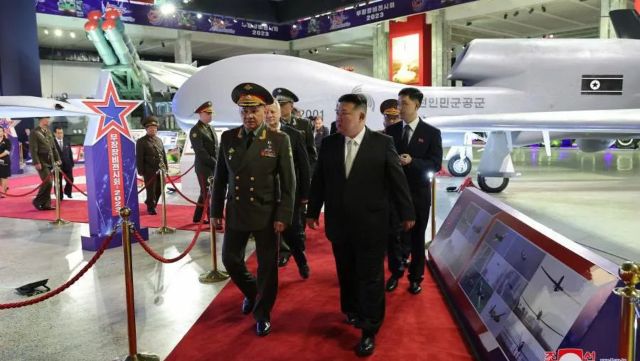
North Korean leader Kim Jong-un showed Russian Defense Minister Sergei Shoigu the DPRK’s new unmanned aerial vehicles [UAVs], which resemble US-made military drones, Obektivno.bg reports.

Pictures released by North Korean state media show North Korean drones that look exactly like the US MQ-9 Reaper and the RQ-4 Global Hawk surveillance drone. The drone photos are from the 2023 Arms Show in Pyongyang, attended by Sergei Shoigu and Kim Jong-un during the Russian Defense Minister’s visit to North Korea.
South Korean media commented that North Korea “even conducted test flights of both models”, noting in this regard that if the North Korean version of the RQ-4 and the Global Hawk drones that Seoul purchased from the US were to fly simultaneously over the Korean Peninsula, they would be “identical enough to confuse who is who”.
Is the technology copied?
North Korea’s claims that its drones are indistinguishable from the American originals will clearly be proven in the coming years. But even if that is the case, what matters more is whether the North Koreans were able to copy the technology.

North Korean media does not say how technologically advanced the local drones, copies of American ones, are. Over the years, North Korea has not been successful in developing high-tech weapons, despite its claims. BulgarianMilitary.com recalls that North Korea allegedly supplied missiles to Russia in the war in Ukraine. However, Moscow has remained very disappointed with them and they have decided that there is no need for these “North Korean technological” missiles.
In this regard, let’s recall what the main characteristics of the MQ-9 are. The Reaper has a wingspan of 66 feet and a length of 36 feet. It can fly at a maximum altitude of 50,000 feet and has a maximum speed of 300 knots.
The MQ-9 Reaper is equipped with a variety of sensors that allow it to gather intelligence and surveillance data. These sensors include electro-optical/infrared [EO/IR] cameras, synthetic aperture radar [SAR], and signal intelligence [SIGINT] equipment. The EO/IR cameras provide high-resolution imagery and video in both daylight and nighttime conditions. The SAR allows the Reaper to see through clouds and other types of weather, providing a clear view of the ground below. The SIGINT equipment allows the Reaper to intercept and analyze electronic signals, such as radio and radar transmissions.
The MQ-9 Reaper’s sensors work by gathering data from the environment around the UAV. The EO/IR cameras use visible and infrared light to create images and videos of the ground below. The SAR emits radio waves that bounce off the ground and other objects, creating a detailed image of the terrain. The SIGINT equipment intercepts electronic signals and analyzes them to determine their source and purpose. All of this data is transmitted back to the ground control station, where it is analyzed by human operators.
How can North Korea copy US drones?

American drones, like any other known in the military industry, are not invincible. BulgarianMilitary.com has repeatedly reported the downing of American drones, including the MQ-9 Reaper, in various locations around the world.
We will not go into great detail, nor will we describe all the downed US drones. But, US MQ-9 Reaper drones have been shot down in various locations and at different times. One of the most notable incidents occurred on June 20, 2019, when Iran’s Islamic Revolutionary Guard Corps [IRGC] shot down a US MQ-9 Reaper drone over the Strait of Hormuz.
Another incident happened on October 1, 2019, when Houthi rebels in Yemen claimed to have shot down a US MQ-9 Reaper drone over the northern province of Amran. In September 2020, the US military reported that two MQ-9 Reaper drones had been shot down over Yemen. The Houthis claimed responsibility for the attacks.
These incidents highlight the vulnerability of the US MQ-9 Reaper drones and the ongoing conflicts in the Middle East.
***
Follow us everywhere and at any time. BulgarianMilitary.com has responsive design and you can open the page from any computer, mobile devices or web browsers. For more up-to-date news, follow our Google News, YouTube, Reddit, LinkedIn, Twitter and Facebook pages. Our standards: Manifesto & ethical principles.