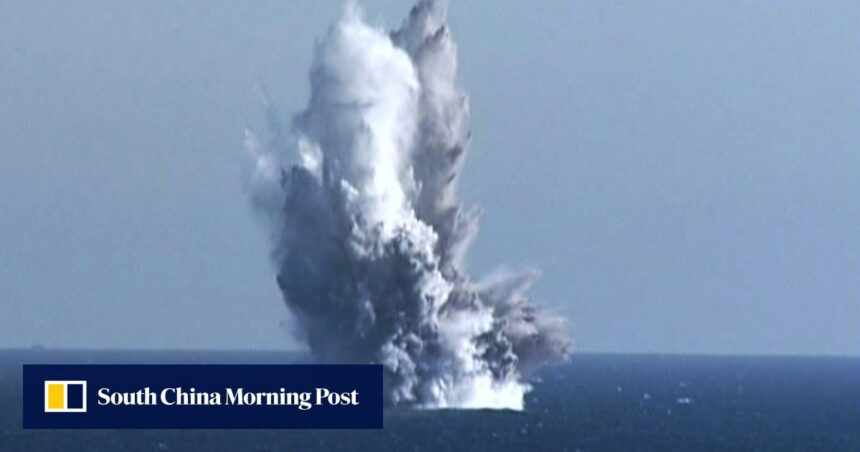
During the drill, the new North Korean drone cruised underwater at a depth of 80 to 150m (260-500ft) for over 59 hours and detonated in waters off its east coast on Thursday, North Korean state news agency KCNA said.
Dubbed “Haeil”, or tsunami, the drone system is intended to make sneak attacks in enemy waters and destroy naval striker groups and major operational ports by making a super-scale radioactive wave through an underwater explosion, the KCNA said.
North Korea says ‘will surely annihilate the enemy’ with missiles if needed
North Korea says ‘will surely annihilate the enemy’ with missiles if needed
It is unclear whether North Korea has fully developed miniaturised nuclear warheads needed to fit on its smaller weapons.
A South Korean military official said they were analysing the North’s claims. A US official, speaking on the condition of anonymity, said there was no indication of a nuclear test.
Analysts say perfecting smaller warheads would most likely be a key goal if the North resumes nuclear testing.
Leif-Eric Easley, a professor at Ewha University in Seoul, said Pyongyang’s latest claim to have a nuclear-capable underwater drone “should be met with scepticism.”
“But it is clearly intended to show that the Kim regime has so many different means of nuclear attack that any pre-emptive or decapitation strike against it would fail disastrously,” he said.
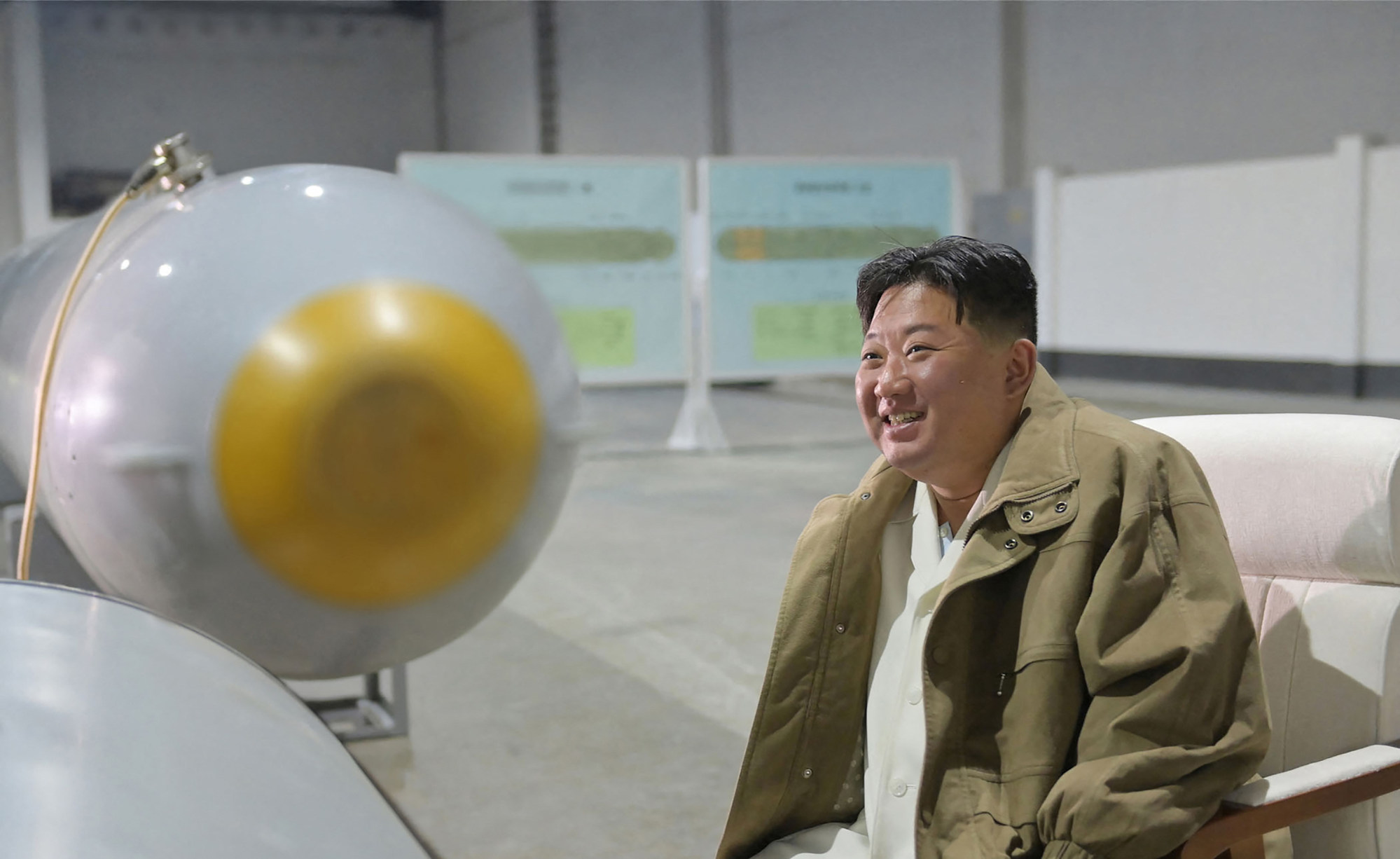
A photo released by state media showed Kim smiling next to a large torpedo-shaped object, but did not identify it as the new drone. Other photos showed tracks of the object’s underwater trajectory, and blasts visible on the sea surface.
KCNA also confirmed the North fired cruise missiles on Wednesday to practice carrying out tactical nuclear attack missions, confirming earlier reports from the South Korean military.
The cruise missiles were tipped with a “test warhead simulating a nuclear warhead,” and flew 1,500-1,800km (930-1120 miles), according to KCNA.
The drill verified the reliability of its control devices and detonators in a mid-air explosion and served as a demonstration of another military attack capability, KCNA added.
The North said the latest weapon test and drills had no negative impact on security of the neighbouring countries.
The latest tests took place as South Korean and US troops launched their largest amphibious landing drills in years, involving a US amphibious assault ship, on Monday.

01:10
North Korea’s ‘first daughter’ watches new missile launch alongside father, Kim Jong-un
North Korea’s ‘first daughter’ watches new missile launch alongside father, Kim Jong-un
North Korea said the US and South Korea were driving the situation on the Korean peninsula to an “irreversibly dangerous point” with their exercises, and that such moves require its forces to “gird themselves for an all-out war and bolster up its nuclear force both in quality and quantity on a priority basis.”
The US ship, USS Makin Island, docked at a naval base in South Korea’s southeastern port city of Busan on Wednesday, carrying 10 F-35 stealth fighters.
Pyongyang has long bristled at exercises conducted by South Korean and US forces, saying they are preparation for an invasion of the North.
South Korea should build nuclear weapons to defend against North: Seoul’s mayor
South Korea should build nuclear weapons to defend against North: Seoul’s mayor
South Korea and the US say the exercises are purely defensive and have criticised the tests as destabilising and in breach of UN sanctions.
The allies concluded 11 days of their regular springtime exercises, called Freedom Shield 23, on Thursday, but they have other field training exercises continuing.
Kim expressed “his will to make the US imperialists and the South Korean puppet regime plunge into despair for their choice,” KCNA said, adding that he warned the enemies that they should stop reckless anti-North Korea war drills.