The inspectors’ latest trek, in February, yielded the usual matrices of readings and measurements, couched in the clinical language of a U.N. nuclear watchdog report. But within the document’s dry prose were indications of alarming change.
In factory chambers that had ceased making enriched uranium under a 2015 nuclear accord, the inspectors now witnessed frenzied activity: newly installed equipment, producing enriched uranium at ever faster speeds, and an expansion underway that could soon double the plant’s output. More worryingly, Fordow was scaling up production of a more dangerous form of nuclear fuel — a kind of highly enriched uranium, just shy of weapons grade. Iranian officials in charge of the plant, meanwhile, had begun talking openly about achieving “deterrence,” suggesting that Tehran now had everything it needed to build a bomb if it chose.
Fordow’s transformation mirrors changes seen elsewhere in the country as Iran blows past the guardrails of the Iran nuclear accord. Six years after the Trump administration’s controversial decision to withdraw from the pact, the restraints have fallen away, one by one, leaving Iran closer to nuclear weapons capability than at any time in the country’s history, according to confidential inspection reports and interviews with officials and experts who closely monitor Iran’s progress.
While Iran says it has no plans to make nuclear weapons, it now has a supply of highly enriched uranium that could be converted to weapons-grade fuel for at least three bombs in a time frame ranging from a few days to a few weeks, current and former officials said. The making of a crude nuclear device could follow in as little as six months after a decision is made, while overcoming the challenges of building a nuclear warhead deliverable by a missile would take longer, perhaps two years or more, the officials said.
Iran recently has sought to dilute some of its highly enriched uranium, signaling, in the view of U.S. officials, that it is seeking to avoid a conflict by self-imposing limits on its supply of near-weapons-grade fuel. But Fordow’s machines are making highly enriched uranium at a faster rate than ever before, and the country’s combined stocks of uranium fuel continue to increase, records show. The trend is unmistakable: From interviews with International Atomic Energy Agency (IAEA) officials at the nuclear watchdog’s Vienna headquarters and with more than a dozen current and former U.S. and European intelligence and security officials — many of whom spoke on the condition of anonymity to discuss sensitive matters — the emerging view is one of Iran advancing slowly but confidently, accumulating the means for a future weapon while making no overt move to build one.
The collapse of the deal, meanwhile, has sharply curtailed the IAEA’s ability to monitor Iran’s activity or investigate any reports of secret weapons activity, the officials and experts said. A U.S. official with knowledge of internal discussions at the IAEA’s governing board conceded that the nuclear watchdog is less capable now of detecting a nuclear breakout by Iran. Such an event could bring cascading consequences, from a Middle East arms race to a direct Israel-Iran conflict that could unleash a wider regional war, said the official.
For now, the U.S. official said of Iran, “they are dancing right up to the edge.”
President Biden vowed early in his presidency to seek to restore or revamp the deal, but the administration’s efforts ran into a wall of political opposition at home and indifference from Iran. In December 2022, a video recording captured Biden acknowledging that the accord was “dead,” although the administration has not said so formally.
White House national security spokesman John Kirby recently acknowledged what he called the “futility” of the effort to revive the deal, and said the administration had “stopped putting energy and effort into it.” He said Biden remains determined to stop Iran from acquiring the ability to make nuclear weapons, but he conceded that the United States has few fewer tools to achieve that end.
“He would prefer — vastly prefer — to do that through diplomacy,” Kirby said in a White House briefing in September. “But that’s just not a viable option right now.”
A broken pact spurs Iranian defiance
The 2015 Iran nuclear accord — negotiated during Barack Obama’s presidency by the United States and five other world powers, plus the European Union, and known as the Joint Comprehensive Plan of Action, or JCPOA — is technically still in effect, even if only as a shell. European countries continue to recognize the accord, and IAEA inspectors are allowed to visit Fordow and a few other facilities under preexisting agreements. But since the U.S. withdrawal, Iran has asserted its right to cancel any parts of the agreement it wants to ignore. In practice, that means almost all of it.
Under the pact, effective in early 2016, Iran agreed to accept severe curbs on its ability to make enriched uranium or other fissile material that could be used to make nuclear weapons. In exchange for sanctions relief, Iran also agreed to intrusive monitoring and inspections and to tight limits on its total uranium stockpile, ensuring that Tehran could not accumulate enough enriched uranium to produce even a single bomb.
But the agreement drew widespread criticism, including from congressional Republicans and some Democrats who opposed sanctions relief for Iran and expressed skepticism over Tehran’s intentions to honor the agreement. The Israeli government attacked the accord as broadly inadequate, criticizing in particular its “sunset” provisions that allowed several key restrictions to expire in just 15 years, by 2031.
Donald Trump vowed as a presidential candidate that he would withdraw from the JCPOA and did so in 2018, calling the agreement a “horrible one-sided deal that should have never, ever been made.”
The Trump administration instead reimposed old sanctions and added new ones in an unsuccessful unilateral attempt to pressure Tehran. Iran’s response was to begin systematically flouting the accord’s major provisions while blasting the United States for negotiating in bad faith.
Today, six years after the pullout, Tehran has bolted past nearly all the pact’s constraints on the amount and type of enriched uranium it can possess, IAEA documents show. Iran’s actions appear to have been emboldened, U.S. and European diplomats say, by its deepening alliance with Russia, a signatory to the JCPOA that has emerged as an important strategic and economic partner since Moscow’s full invasion of Ukraine in February 2022.
“The alliance with Russia makes a difference regarding how Iran feels towards the United States and the Europeans — you can see that they now feel very comfortable” about defying the West, said a senior European diplomat, speaking on the condition of anonymity to discuss sensitive internal deliberations at the IAEA’s 35-nation board of governors.
Whether Iran will ultimately decide to make a nuclear bomb is unclear. Iran’s leaders have been cautious about risking a direct confrontation with Israel or the United States, as would almost certainly happen if a secret bombmaking program was discovered.
Iran’s supreme leader, Ayatollah Ali Khamenei, who issued a fatwa — or religious edict — against nuclear weapons in 2003, repeated his official opposition in a June 2023 speech, declaring weapons of mass destruction to be “contradictory to Islam.” He said Western countries “know very well that we are not pursuing nuclear weapons.” Iranian officials frequently accuse Western governments of hypocrisy in focusing on Iran’s nuclear program while saying nothing about Israel, a nuclear-armed country that is not subject to IAEA oversight.
Emails requesting comment from Iran’s mission to the United Nations were not answered.
Freed of the deal’s restraints, Iran appears to believe that it has a legal, slow-but-sure path to becoming a threshold nuclear state — a country that possesses the means for making nuclear bombs but stops just short of doing so — without putting itself at risk of a military strike, intelligence officials and weapons experts said.
“They’re not crossing red lines — they’re moving boundaries,” said Robert Litwak, a nonproliferation expert and senior vice president at the Woodrow Wilson International Center for Scholars, a Washington think tank. “Hedging is Iran’s sweet spot.”
Iran’s nuclear inner sanctum
One of the profound changes envisioned by the architects of the JCPOA was the transformation of the underground facility known formally as the Fordow Fuel Enrichment Plant. Designed by Iran as a secret factory for making enriched uranium, it was built inside tunnels cut 300 feet into the side of a craggy mountain just northeast of Qom, an ancient city and pilgrimage site in arid north-central Iran. Western intelligence agencies detected the facility while it was still under construction, and Obama revealed the plant’s existence to the world in 2009.
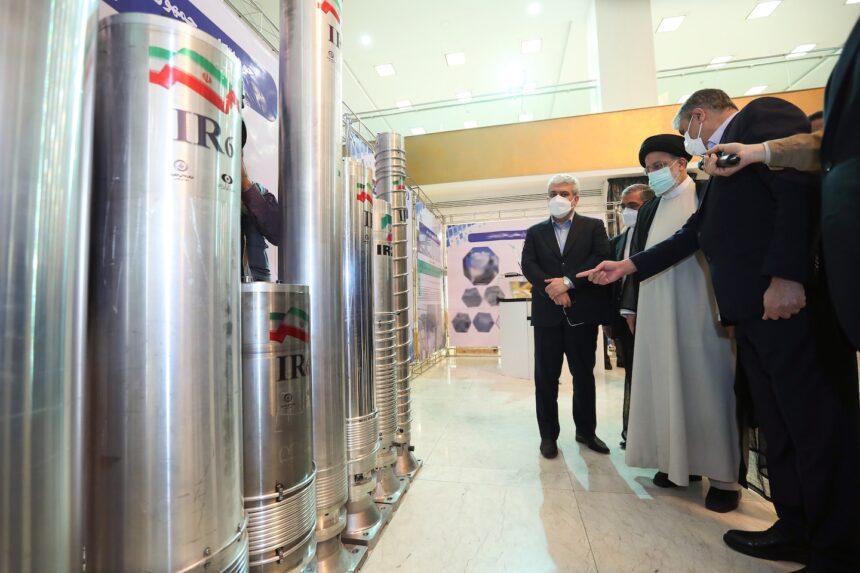
Before the 2015 nuclear deal, Fordow’s gleaming production halls hummed with the sound of about 3,000 centrifuges. These slim cylindrical machines spin at supersonic speeds to create a form of uranium that contains higher concentrations of an isotope called U-235, the part of uranium that can be easily split to create a nuclear chain reaction. Even in the plant’s pre-JCPOA days, Fordow produced only low-enriched uranium with a U-235 purity of 3 to 20 percent, IAEA documents show. That’s typical of the uranium fuel used in civilian nuclear power reactors.
Fordow now is a symbol of the nuclear deal’s collapse. Under the pact, most of Fordow’s centrifuges were mothballed, and the rest were allowed to make isotopes only for medical applications and civilian research. All fissile uranium was removed. Then, after the Trump decision in 2018, the plant slowly came back to life. Since 2018, IAEA inspectors have watched production of enriched uranium at Fordow go from zero to more than 700 pounds a month this past February, according to the latest IAEA report released to member states last month.
The qualitative difference in the fuel is even more startling. Fordow’s most refined product today has a U-235 purity of 60 percent, IAEA reports show.
“There is no reason to be at 60 percent,” said a second European diplomat privy to internal discussions of the IAEA’s governing board. “Sixty percent is very close to weapons grade. They could go there with the flip of a switch.”
Fordow began making the highly enriched fuel in 2022, but the rate of production has steadily increased over the past two years. Iran’s largest uranium-enrichment plant, at Natanz, also now makes uranium enriched to 60 percent, and the combined stockpile of the fuel stood at nearly 270 pounds when inspectors visited in February, the reports show.
In what Western governments interpreted as a conciliatory gesture, Iran in recent months began diluting some of the high-enriched fuel to prevent the total from climbing precipitously. But Iran’s current stockpile already could yield enough weapons-grade uranium for at least three bombs, current and former U.S. officials and weapons experts said. The conversion to bomb-grade fuel is relatively simple using Iran’s existing equipment, and could happen in a time frame ranging from days to a few weeks, the officials said.
Iran is believed to possess nearly all the technological know-how and equipment it needs to build a crude nuclear device. Documents stolen from a Tehran warehouse by Israeli operatives in 2018 confirmed what U.S. intelligence agencies had concluded years earlier: Iran launched a crash program on a nuclear weapons design in the early 2000s before apparently abandoning the effort in 2003, around the start of the U.S. invasion of Iraq. Documents released by Israelis showed Iranians developing and testing components for a nuclear device in the early 2000s.
“They have already taken most of the steps they would need to take,” said David Albright, an expert on Iran’s nuclear program and the president of the Institute for Science and International Security, who has analyzed many of the documents. Iran’s most significant challenge in the early 2000s was obtaining highly enriched uranium or plutonium for a bomb, and “they have solved that problem, even better than they expected. You can tell from their statements that they are well aware of what they have,” Albright said.
The enhanced capabilities are reflected in a new boldness in Iran’s public statements about its nuclear facilities.
Earlier this year, the head of the Atomic Energy Organization of Iran used a provocative term, “deterrence,” in describing the purpose of Iran’s nuclear program. In a nuclear weapons context, “deterrence” refers to the threat that a country would use weapons of mass destruction in response to aggression by another power.
Referring to Iran’s nuclear program in a January interview, AEOI Director Mohammad Eslami specifically said that “deterrence has been achieved with the help of God, without having to violate any rules or regulations.”
“In terms of our national security, we do not want to do it,” Eslami said of Iran’s philosophy regarding nuclear weapons. But then he added: “It is not about the lack of capability. This is a very important point. … We should not underrate our current achievements, thinking that we are not there yet.”
Eslami’s predecessor at the AEOI, Ali Akbar Salehi, summarized the state of affairs more colorfully in a February interview, likening Iran’s nuclear program to a collection of automobile parts that only need to be assembled. “Have you made a gearbox? I say yes. An engine? But each one is for its own purpose.”
The comments drew an uncharacteristically sharp rebuke from the IAEA, an organization whose mission is to prevent the spread of nuclear weapons, assembled or not.
“All this loose talk about nuclear weapons is extremely unhelpful, and I frankly deplore it,” IAEA Director General Rafael Mariano Grossi said in an interview. “If you are a party to the Nuclear Non-Proliferation Treaty, you are not supposed to have nuclear weapons in any way — assembled, disassembled, in a drawer, in a cupboard, or whatever. You should not pursue it; you should not have it. Period.”
A nuclear ‘domino effect’
In a region beset by war — both the hot war in the Gaza Strip and the long-running shadow conflict between Iran and Israel — Tehran’s progress is being monitored with growing unease. Israel’s military and spy services have a long history of covert action to slow Iran’s nuclear progress, from assassinations of Iranian scientists to cyberattacks on nuclear facilities, including the cyber-sabotage operations known as Stuxnet. Emerging evidence of an Iranian nuclear breakout effort could trigger Israeli airstrikes on Tehran’s nuclear facilities. A retaliatory salvo from Iran’s increasingly sophisticated missile or drone fleet could spark a wider Middle Eastern war.
The specter of a nuclear-capable Iran could also prompt other countries in the region — including Saudi Arabia and Turkey — to reconsider their security choices. Grossi, in the interview, warned of the potential for a destabilizing “domino effect.”
“More than one country has expressed, literally, that seeing Iran having a nuclear capability would trigger themselves to seek that capability as well,” he said. If that happens, he added, it could lead to “potentially unraveling the nonproliferation regime writ large.”
Mindful of the growing danger, Grossi has called urgently for the 2015 agreement to either be reinstated or replaced with a new version, to give Iran’s neighbors more clarity about its nuclear intentions.
“If we are left in limbo, bad things may happen,” he said.
For now, prospects for restoring or revising the pact remain gloomy, as even ardent supporters of the JCPOA acknowledge. With no agreement in place, persuading Tehran to step back from the edge will probably be difficult at best, current and former U.S. officials said.
“It’s going to be pretty awkward to get back to a place of confidence, where we know that Iran has not moved to within epsilon of having a nuclear device,” said Ernest Moniz, the physicist and former U.S. energy secretary who helped negotiate the 2015 accord.
“Any real progress that might come in the future will almost certainly have to be part of a broader agreement” between Iran and the West, said Moniz, who is now CEO of the Nuclear Threat Initiative, a Washington nonprofit. “And that will be very challenging and probably extremely difficult to reach.”