- By Dearbail Jordan
- BBC News
Image source, Getty Images
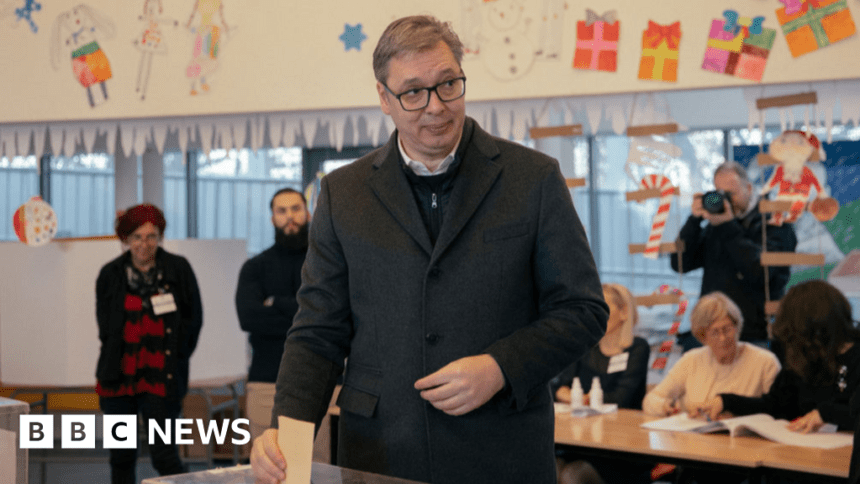
President Aleksander Vucic said he expected a decisive victory
Serbians have voted in snap elections that are forecast to keep President Aleksandar Vucic’s party in power.
Polls closed at 20:00 (19:00 GMT), and his Serbian Progressive Party is likely to keep its majority in parliament.
But opposition parties campaigning under a Serbia Against Violence banner are hoping to challenge his party in local elections, in the capital Belgrade in particular.
Election officials put the turnout at 51.93% with two hours of voting to go.
The SNS has been in power since 2012 but there have three elections in the past three years. President Vucic said on Sunday that he expected “a good turnout and a decisive victory”.
The loose opposition alliance was formed after two mass shootings in May which sparked huge protests. The attacks killed 19 people, including 10 at a school in Belgrade.
The protests grew into demonstrations against President Vucic and his SNS party.
Opposition parties said the massacres reflected a culture of rhetorical and physical violence promoted by the ruling party and its allies in the media.
Serbia is also struggling with high inflation, which hit 8% in November.
President Vucic is under pressure from the European Union (EU) and the US to normalise relations with Kosovo.
Serbia is a candidate to become a member of the European Union.
Kosovo declared unilateral independence from Serbia in 2008, and whilst it is recognised by more than 100 UN members, Serbia has refused to do so – backed by allies like Russia, China and five EU members.
Serbia has also declined to impose sanctions against Russia over its invasion of Ukraine.
The loose coalition of opposition parties running under the Serbia Against Violence banner were in favour of holding this latest election.
As well as the parliamentary ballot to secure a four-year term, there are a number of municipal seats up for grabs, including in the Serbian capital, Belgrade.
Analysts say the battle for the capital is important because of its strong symbolic significance and being the only place where the opposition has a good chance of victory.
On Sunday, Dragan Djilas, the former mayor of Belgrade and a leader of the Serbia Against Violence alliance, told Reuters news agency that “changes in Serbia have begun.”
He said: “People are determined to live… normally without crime and corruptions, without prices going wild.”