If France and Germany, Dassault Aviation and Airbus DS, actively cooperate in the design of the FCAS program, they nonetheless remain competitors regarding current programs, Rafale and Eurofighter Typhoon, in particular.
While the date of entry into service of the new 6th generation European fighter tends to slip from 2040 to 2045, or even 2050, depending on the sources, the need to equip Rafale and Eurofighter which they will replace, new capabilities allowing engagement in a heavily contested environment, have convinced Armies and Air Forces and industrialists, on both sides of the Rhine, to engage in the development of combat drones.
Regarding the design of heavy combat drones, or Loyal Wingmen, which will accompany French and German aircraft, these are precisely the two industrialists, also partners within FCAS, and rivals with the Rafale and Typhoon, Dassault aviation and Airbus DS, which are in charge of this mission.

The study of the combat drone derived from the Neuron to support the Rafale F5, entrusted to Dassault Aviation
Announced on the occasion of the development of the 2024-2030 Military Programming Law, the start of the design of a combat drone to support future Rafale F5, was eagerly awaited, including by the main interested party, Dassault Aviation.

It is now a done deal, if we are to believe the website LaTribune.fr, which reveals that an initial study contract worth 130 million euros was awarded to the French aircraft manufacturer, for the first phase of design of a combat drone derived from the Neuron demonstrator.
For the moment, both the Ministry of the Armed Forces, the DGA, the Armed Forces and French industrialists have remained very discreet on this subject. The best we know is that, according to Eric Trappier, the president of Dassault Aviation, the device will have to be larger and heavier than the Neuron, if it wants to effectively support the Rafale F5 in its missions, and that it is expected to enter service at the beginning of the next decade, as part of the future LPM.
We do not know, in particular, whether or not the new combat drone can be taken on board the French aircraft carrier. This would undoubtedly represent a formidable asset for the on-board aerial group, but risks significantly complicating the drone design work, and therefore extending deadlines and increasing costs.
Knowing the convolutions necessary to already fit all of the planned programs into the budget envelope planned for LPM 2024-2030, we can fear that this option will not be retained in Dassault’s specifications.
Airbus DS presents a 1:1 model of its Loyal Wingmen to accompany the Eurofighter Typhoon of the Luftwaffe
If the development of the French combat drone, derived from the Neuron, had been formalized for a year now, that of a Loyal Wingmen type drone, on the other side of the Rhine, had only been discussed, more or less. less direct, by the German Ministry of Defense, and by the Luftwaffe.

Fact, the announcement made by Airbus DS, on June 3, regarding the presentation, at the ILA exhibition in Berlin, from June 5 to 9, of a 1:1 scale model of the future Loyal Wingmen drone intended to accompany the Eurofighter Typhoon of the Luftwaffe, surprised many specialists.
Not, however, that Airbus DS’s skills in this area could be doubted. The aircraft manufacturer has, in fact, developed several programs in the years 2000 and 2010, to acquire effective know-how in the field of stealth combat drones, in particular with the EADS Barracuda, first, then with the mysterious Lout program, more recently.
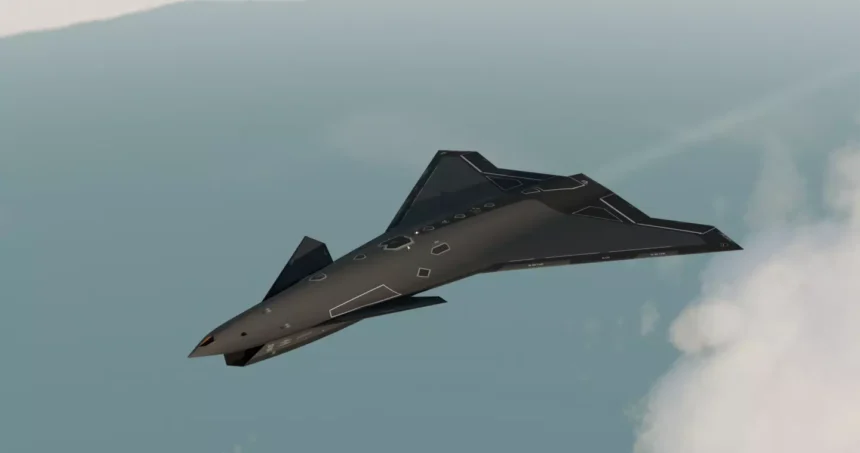
The visual accompanying the public announcement (in the main illustration) on the Airbus DS website, shows a combat drone that is more elongated than traditional stealth drones, such as the Neuron, the X-47 or the Sharp Sword, and is closer from Turkish Kizilelma, of which it takes the canard configuration aligned on the horizontal plane of the wing, to preserve its stealth (as is the case of the Chinese J-20).
On the other hand, unlike the Turkish model, the German model does not have vertical planes, which should increase its stealth, particularly with regard to low frequency radars.

This configuration appears designed to achieve greater speed and greater maneuverability than traditional stealth drones, but should have a smaller payload capacity and range, all things considered.
According to Airbus DS, the objective is to provide Typhoon Germans with additional capabilities through an economical Loyal Wingmen type combat drone, likely to make the connection, in terms of collaborative and info-centric combat, and system of systems, with the FCAS.
Loyal Wingmen and Remote Carrier, the essential appendages, from 2030, to the evolution of modern combat aircraft
If the interest of the French and German air forces in stealth combat drones dates back to the 2000s, it is the war in Ukraine, which breathed new life into these programs, hitherto considered in the longer term, can -be within the framework of FCAS.
For the first time, in fact, multi-layered integrated defense systems, both Ukrainian and Russian, managed to almost completely neutralize the adversary’s air power. And not the least, since the Russian air forces fielded, at the start of the conflict, more than 1200 fighter and attack aircraft, and around a hundred heavy bombers.

Despite the superior performance of modern European fighters compared to Russian tactical combat aircraft, it quickly became urgent in Europe to equip yourself with the necessary means to ensure real air superiority in the event of a conflict against Russia, or any adversary relying on a similar ground-air architecture.
Let us remember, in fact, that a country like France has more combat planes than tanks, which says a lot about the dependence on air superiority, in the firepower delivered.
Although discreet, and objectively effective and balanced, 4th generation combat aircraft, such as the F-15, F-16 or Mirage 2000, and 4.5 generation, like the Eurocanards, do not have the native possibility of evolve towards more passive stealth, nor to reach speeds and ceilings putting them in relative safety.
Cooperation with combat drones, less expensive, natively stealthy, but requiring in situ control from combat aircraft, has therefore quickly become essential, both to locate targets and to increase the number of effectors on the aerial battlefield.
In this area, two families of drones seem to have emerged. The Loyal Wingmen, first of all, heavier combat drones, with performances close to those of the combat planes they accompany, but whose high blows (although lower than the combat planes themselves), in will limit use. Consumable drones, which are lighter, are most often airborne, and intended to decoy, or even attract enemy fire, or to operate in very heavily defended spaces to force air defenses to reveal themselves.

The development of these drones is therefore now a necessity, both for the French and German air forces, in particular in the face of the growing risks of confrontation with Russia, but also to preserve the attractiveness of their current combat aircraft on the international scene, in particular, towards customers who cannot, or do not want to turn to natively stealthy fighters, while waiting for the FCAS NGF to be able to take over in all these areas.
Sweden, Greece, Belgium…: France has an interest in opening the combat drone program derived from the Neuron to certain European partners.
The fact remains that developing a combat drone, even starting from a very successful demonstrator like the Neuron, is an expensive exercise, especially since it will be necessary, after the design, to acquire them to equip the armies in numbers. sufficient, adapt the infrastructures for their maintenance, then train staff in their use.
However, as mentioned previously, these costs will be difficult to bear within the framework of the current LPM, and even more so in the next one, which will have to jointly finance numerous very expensive acquisition programs (FCAS, MGCS, SSBN3G, PANG, etc.) .
If the opening of this program to European cooperation is not, for the moment, mentioned, it would not lack interest, in terms of budgetary sustainability, in the short and medium term. First, by reducing the weight of investments, then, by increasing the addressable fleet, and therefore the tax and social revenues resulting from these exports.
In this area, France could turn to several European partners, in particular concerning the countries which participated in the Neuron program. Among them, Sweden would be a prime candidate, especially since the country will certainly need a drone of this type for its Gripen E/F, for the Flygvapnet, and for export.

On the other hand, collaboration in this area could constitute a first step in the rapprochement between the Swedish new generation combat aircraft program and FCAS, in particular if the objective is to design a second, single-engine aircraft, within the framework of the FCAS technological standard.
Greece, too, participated in the Neuron program, and would certainly have a great interest in participating in a combat drone program, aimed at equipping the Rafale. This would allow its defense aeronautical industry to increase its activity and its skills, while encouraging Athens to favor the hypothesis Rafale F5 + Drones, facing the F-35A.
Belgium did not participate in the Neuron program, and turned to the F-35A to replace its F-16s. However, the country is making numerous efforts to increase its interoperability with the French armies, and to support its aeronautical industry as part of the FCAS program.
Letting Brussels embark on this program would send a powerful message to this country which will have to almost double its defense budget in the years to come, to the point, perhaps, of convincing the Belgian authorities to equip themselves with one or two squadrons of Rafale F5, rather than additional F-35s.

Croatia, but also Poland, could finally join this program. If, for Zagreb, it would be a French effort linked to the order of the 12 Rafale opportunity, and a bet on the future, opening up to Poland would put the Rafale F5 in the lead in the competition for the acquisition of the last two Polish fighter squadrons. Finally, remember that if there are more than three European countries involved in the same program, it becomes eligible for European aid.
Italy, Great Britain and Spain: obvious partners for the German Loyal Wingmen around the Eurofighter
For Berlin, the equation concerning the development of its combat drone is simpler and more direct. Indeed, Germany will be able to turn to its three partners within the Eurofighter program, whether to propose co-development, or even simply to sell the drone developed.
There is little doubt that London would see an interest in this, especially since, like France, the United Kingdom is struggling to finance all of its programs, even taking into account the increase in the army budget. The same goes for Italy and Spain, traditionally flexible and attractive in terms of cooperation.

However, beyond these “native” partners, Berlin could also be more proactive, by opening opportunities for cooperation with other European actors, including Sweden and Poland, mentioned previously, and for the same motives.
However, as the European Sky Shield Initiative has shown, Germany knows perfectly how to seize this type of opportunity, to impose itself at the heart of the construction of European defense, relying in particular on its key assets. , to attract its European partners, to the greatest benefit of its own industry.
Conclusion
If European cooperation does not have much good press, today, in France, it can, when articulated effectively, prove to be a powerful tool, for the benefit of the national defense effort, but also for the construction of lines of defense. forces underlying the emergence of a European defense.
In this area, the Loyal Wingmen combat drone program, derived from the Neuron, announced by Sébastien Lecornu last year, can potentially create particularly promising cooperation opportunities for Paris and the French defense industry, with some of their neighbors. Europeans, as long as the French agree to play “in several bands”.
Otherwise, we can expect that Berlin, and Airbus DS, will take advantage of the situation to strengthen a position already consolidated by the ESSI, and which would then necessarily spill over into the FCAS program, as on geopolitical balances in Europe.
Article from June 4, 2024 in full until July 13, 2024