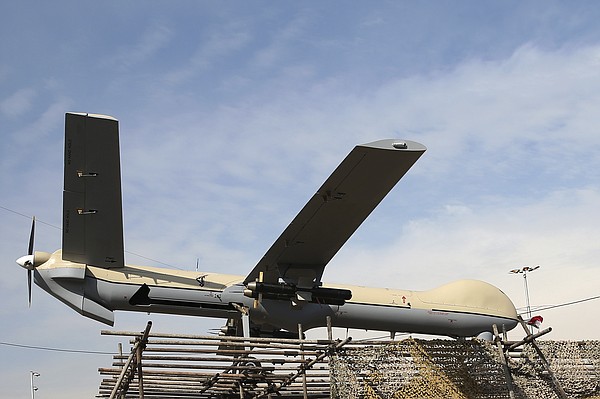
WASHINGTON — The White House on Monday said Russia is looking to buy additional advanced attack drones from Iran for use in its war against Ukraine after using up most of the 400 drones it had previously purchased from Tehran.
The Biden administration last year publicized satellite imagery and intelligence findings that it said indicated Iran sold hundreds of attack drones to Russia. And for months, officials have said the United States believed Iran was considering selling hundreds of ballistic missiles to Russia, but Washington did not have evidence a deal was consummated.
“Iran also continues to provide Russia with one-way attack UAVs (unmanned aerial vehicles). Since August, Iran has provided Russia with more than 400 UAVs primarily of the Shahed variety,” White House National Security Council spokesman John Kirby said.
“Russia has expended most of these UAVs, using them to target Ukrainian critical infrastructure inside Ukraine. By providing Russia with these UAVs, Iran has been directly enabling Russia’s war of aggression in Ukraine,” Kirby told reporters.
The Shahed drones that Russia has already purchased are packed with explosives and programmed to loiter overhead until they nosedive into a target — unmanned versions of World War II kamikaze pilots who would fly their explosives-laden planes into U.S. warships in the Pacific.
Kirby said the Russians are now looking at acquiring even more advanced drones “capable of more lethality.”
The latest revelation is part of a persistent drip of intelligence findings from the administration to detail what U.S. officials say is a deepening defense partnership between Russia and Iran. The U.S. allegations are part of a broader effort to declassify and publicize intelligence findings concerning Moscow’s prosecution of its nearly 15-month war in Ukraine in hopes of furthering global isolation of Russia.
The Biden administration says the Kremlin’s reliance on Iran as well as North Korea — countries largely isolated on the international stage for their nuclear programs and human rights records — shows desperation. That’s in the face of Ukrainian resistance and the success of the global coalition in disrupting Russian military supply chains and denying replacements for weapons lost on the battlefield. The White House says Russia has turned to North Korea for artillery.
U.S. officials say Iran has also provided Russia with artillery and tank rounds for its invasion of Ukraine.
“This is a full scale defense partnership that is harmful to Ukraine, to the region in the Middle East and to the international community,” said Kirby, who added that Iran has been “Russia’s top military backer” since the start of the Ukraine invasion.
Kirby said the administration is looking to further tighten export controls to prevent Western components from making their way to Iran for use in manufacturing drones. He also said further sanctions against Iran and Russia could be coming.
Iran has said it provided drones to Russia prior to the start of the war, but not since. North Korea has denied it has provided Russia artillery.
The White House has said for months that it has seen troubling signs that the military cooperation between Moscow and Tehran could flow both ways.
Iran is seeking to purchase additional military equipment from Russia, including attack helicopters, radars and YAK-130 combat trainer aircraft, according to the White House. And Iran announced in March that it had finalized a deal to buy Su-35 fighter jets from Russia.
The White House has also previously said Russia and Iran were considering starting a drone assembly line in Russia for the Ukraine conflict.
“In total, Iran is seeking billions of dollars’ worth of military equipment from Russia,” Kirby said.
The new allegations come as Biden is headed to Hiroshima, Japan, later this week for the Group of Seven summit, where the U.S. president is expected to make a call to fellow leaders of some of the world’s biggest economies to further tighten export controls and sanctions on Moscow.
SOUTH AFRICA
Russia’s top army general and his South African counterpart discussed “military cooperation” while meeting Monday in Moscow, the Russian Defense Ministry said.
The announcement came hours after South African President Cyril Ramaphosa denied accusations by the United States that his country was siding with Russia in the war in Ukraine and had sent weapons to help it.
Gen. Oleg Salyukov, the commander of Russia’s ground forces, met the chief of South Africa’s army, Lt. Gen. Lawrence Mbatha, at Russia’s general command headquarters in Moscow, the Russian ministry said.
“The sides discussed issues of military cooperation and the implementation of projects geared to enhance the combat readiness of the two countries’ armies,” the ministry said in a statement. “The meeting between the military commanders yielded agreements on the further expansion of cooperation between the land forces in various areas.”
The Defense Ministry said a South African delegation would visit a number of Russian army “educational and training facilities.”
The South African army said the trip was planned well in advance of the U.S. ambassador to South Africa alleging last week that the country had provided weapons to Russia when a ship under U.S. sanctions made a secret stop at a South African naval base in December.
The South African government has denied the Russian cargo ship’s stop involved an official sale of weapons, although it has not categorically ruled out an arms transaction took place.
Ramaphosa has said an investigation was underway to determine if anyone loaded weapons onto the Russian-flagged Lady R cargo ship at the Simon’s Town naval base near Cape Town.
Ramaphosa used his weekly message to the nation Monday to reaffirm South Africa’s non-aligned stance with regard to Russia’s invasion of Ukraine. The president’s statement was seen as a response to U.S. Ambassador to South Africa Reuben Brigety, who questioned South Africa’s neutrality in the Ukraine war while making the allegations about a weapons shipment.
Brigety was subsequently summoned to a meeting with South Africa’s foreign minister.
“We do not accept that our non-aligned position favors Russia above other countries,” Ramaphosa wrote in his weekly message. “Nor do we accept that it should imperil our relations with other countries.”
Ramaphosa added: “We have been firm on this point: South Africa has not been, and will not be, drawn into a contest between global powers.”
He also hinted that Russian President Vladimir Putin would visit South Africa for a meeting of leaders of the BRICS economic bloc in August. The Kremlin has not confirmed that Putin plans to attend the BRICS summit.
Such a trip would entangle South Africa in another diplomatic mess because the country is a signatory to the treaty that created the International Criminal Court, which issued an arrest warrant for Putin in March on charges of war crimes involving the abductions of children from Ukraine.
Since the indictment, Putin has traveled rarely, and only to countries that are close allies of Russia. Countries that are parties to the treaty would be obliged to arrest the Russian leader.
While Russia and South Africa both described Monday’s meeting of the countries’ top army generals as part of a normal bilateral trip, it’s bound to increase scrutiny of Africa’s most developed economy, which is seen as an influential nation in the developing world.
South Africa is the only African nation in the BRICS bloc, which also includes Brazil, Russia, India and China.
Aside from the weapons allegations, South Africa also hosted Russian and Chinese warships and took part in naval exercises off its east coast in February that coincided with the one-year anniversary of Russia’s invasion of Ukraine.
Brigety, the American ambassador, said last week that U.S. officials have “respect for South Africa’s policy of neutrality and non-alignment in international affairs” but had “noted a series of issues which suggest that in practice the government of South Africa is in fact not non-aligned.”
The Associated Press independently verified that the Lady R cargo ship stopped at the South African naval base for at least three days in December, as Brigety claimed. A review of records by the AP also shows that the Lady R is tied to a company that was sanctioned by the U.S. for transporting weapons for the Russian government and aiding its war effort in Ukraine.
Information for this article was contributed by Aamer Madhani, Colleen Long, Zeke Miller, Gerald Imray, Mogomotsi Magome and Dasha Litvinova of The Associated Press.
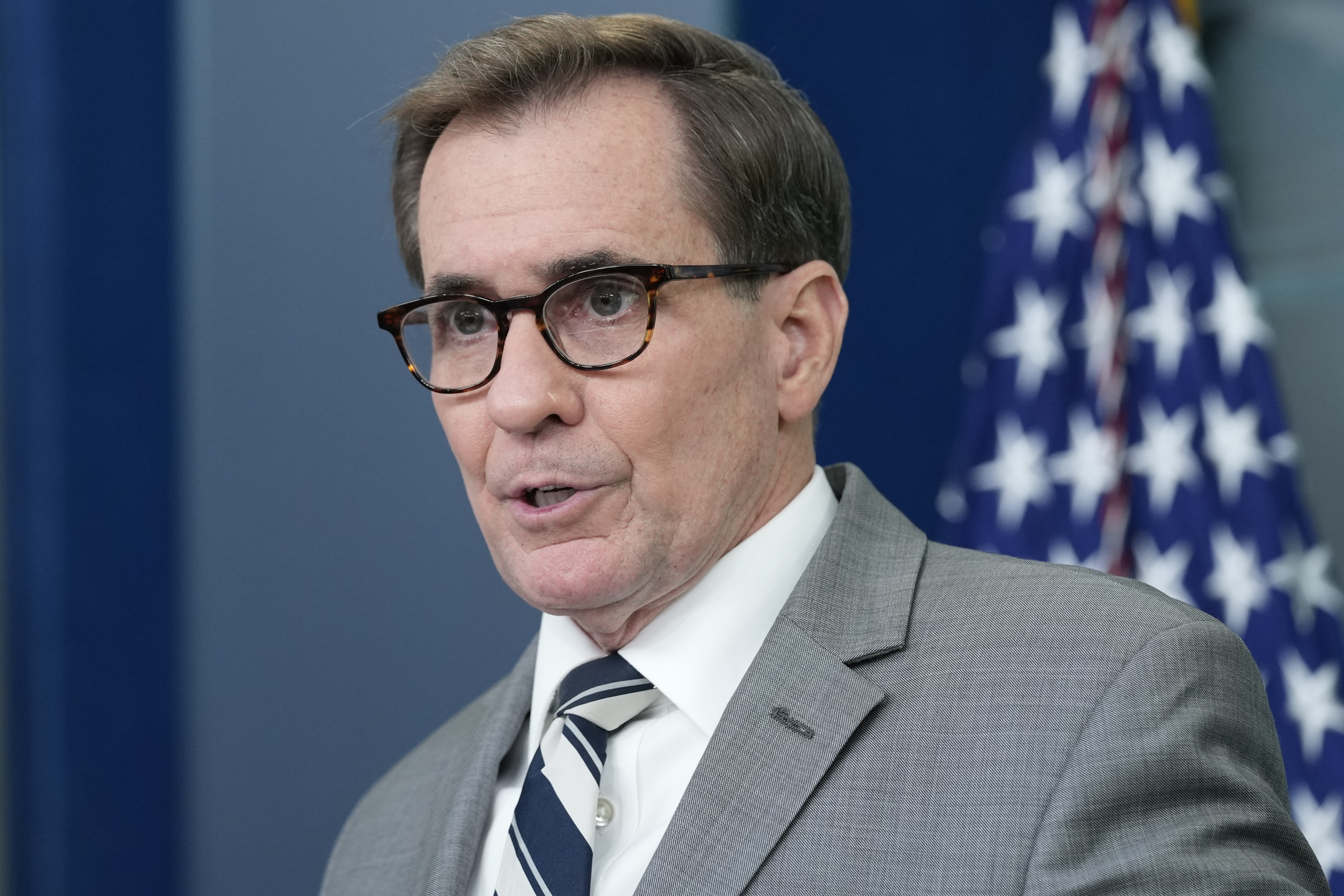 National Security Council spokesman John Kirby speaks during the daily briefing at the White House in Washington, Thursday, April 20, 2023. (AP Photo/Susan Walsh)