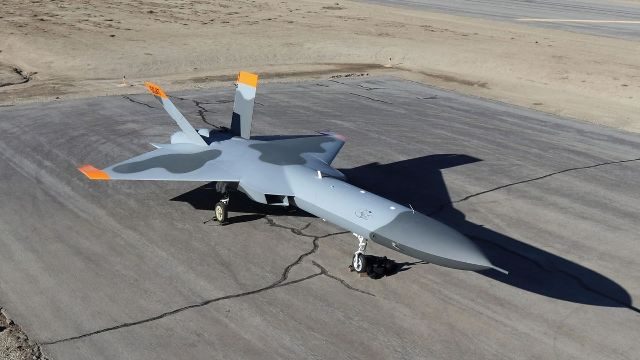
The U.S. Air Force, displaying a keen sense of strategic foresight, has resuscitated a program aimed at procuring a fighter-sized unmanned aircraft possessed of stealth capabilities. The primary function of this innovative and covert drone will be to serve as a target, thus enhancing the fleet’s competencies in contending with enemy stealth fighters.

The organization known as Advanced Technology International garnered a contract worth $77.2 million. The contract, as revealed on the System for Award Management contracting website, is for the development of a 5th Generation Aerial Target [5GAT] prototype.
Given the inadequacies of current target drones in accurately replicating the advanced features of stealth aircraft, the introduction of this new drone emerges as a crucial development. This innovation is especially significant for the comprehensive testing of an array of emerging systems. Among these are the radar mechanisms incorporated into the latest generations of air-to-air missiles.
Undeniably, these entities can serve instrumental roles in facilitating pilot training, more specifically through the simulation of potential threats. This concept has garnered increasing recognition, thereby prompting the U.S. Air Force to establish a specialized aggressor training unit. The unit employs F-35 stealth fighters to mimic the variety of aircraft utilized by potential adversaries – a strategy embodied by the 65th Aggressor Squadron.

Given the scarcity and exorbitantly high operational expenses associated with F-35s, the introduction of the new unmanned stealth aircraft signifies a critical advancement. This innovative drone is set to democratize training opportunities across the naval fleet, thereby equipping more units with the crucial skills to engage stealth targets effectively.
In the current geopolitical landscape, the development of a novel target drone materializes amidst Russia’s ongoing struggle to establish a fully operational unit of stealth fighters, a milestone that remains elusive. This manifests as a poignant reminder of the gap between aspiration and reality, evidenced by the fact that Russia is lagging by more than two decades from the initial Soviet forecast for the deployment of fifth-generation aircraft. Indeed, the original projection anticipated the first MiG 1.42 unit’s deployment as far back as 2001, yet this ambition remains unfulfilled to this day.
Nevertheless, it is China that has risen to prominence as the sole significant proprietor of indigenous fifth-generation fighter aircraft, alongside the United States. The production of its J-20 fighter has witnessed a remarkable uptick, with an annual output of 100-120 units. Furthermore, the sophistication of its avionics is paralleled only by the advanced systems of the F-35.

Undoubtedly, the aircraft in question stands as the most formidable asset within the arsenal of a potential U.S. adversary. It has increasingly earned the recognition of a broad spectrum of analysts, who consider it to be the world’s preeminent air superiority fighter. This high regard is not only due to its rapidly advancing capabilities but also because its American counterpart, the F-22 Raptor, continues to witness a significant deterioration in its avionics.
The J-20B, a recently introduced variant, boasts enhanced stealth capabilities and the incorporation of a novel WS-15 engine, resulting in a significantly elevated performance. This development stands in stark contrast to the persisting and progressively graver issues encountered with the F-35’s engine. These complications have instigated an extensive discourse regarding the necessity for a substitute to progressively retire the F-35 from service.
In March of 2022, the world bore witness to the first verified encounter between the J-20 and the F-35, two formidable airpower titans. This was a year that saw a marked escalation in the deployment of the Chinese J-20 for maritime patrol endeavors, thus illustrating a significant shift in the geopolitical landscape.
Undeniably, the J-20 outperforms the F-35 in several notable areas. It boasts a considerably higher speed and altitude ceiling, coupled with an impressive climb rate. Furthermore, it possesses a supercruise capability that significantly enhances its maneuverability. The J-20 also has a larger radar and missile arsenal, extending its striking capabilities. Notably, it carries air-to-air missiles with a superior range in both visual and beyond-visual range classes, giving it a distinct edge in combat scenarios.

In light of the progressive enhancement of the J-20’s stealth capabilities, it is anticipated that China will introduce an increasing number of stealth aircraft into service. This includes the more lightweight FC-31 fighter, specifically engineered for naval operations, and potentially a significantly lighter, single-engine aircraft designed for its export clientele.
Commencing in 2024, the procurement of J-20s is anticipated to occur approximately 250 percent faster than the rate at which the U.S. Air Force is projected to acquire F-35s. This is largely because the latter service’s orders have been reduced to a mere 48 per annum. The accelerated pace of the Chinese program is exerting increasing pressure on the American fleet, thereby necessitating a heightened sense of urgency in the training against stealth targets.
It is anticipated that the advent of stealthy target drones for testing will considerably enhance the efficacy of a plethora of novel equipment devised exclusively to engage fifth-generation targets. A prime example of such equipment is the newly developed AIM-260 air-to-air missile, which stands to gain substantially from this technological advancement.
Historically, the Air Force has repurposed retired F-16 fourth-generation fighters to function as target drones, a strategy notably employed in the testing of the AIM-260. However, the feasibility of implementing a similar program with its limited supply of fifth-generation fighters is anticipated to be non-existent for several decades. This long-term projection underscores the necessity of investing in the production of purpose-built target drones.
***
Follow us everywhere and at any time. BulgarianMilitary.com has responsive design and you can open the page from any computer, mobile devices or web browsers. For more up-to-date news, follow our Google News, YouTube, Reddit, LinkedIn, Twitter and Facebook pages. Our standards: Manifesto & ethical principles.